

Angela Schottenhammer
Angela Schottenhammer, Mathieu Torck,
Wim de Winter
The Spanish were interested in camphor not solely for medicinal but also for commercial purposes. Borneo camphor, for example, was of excellent quality and early on prompted the Spanish not only to use it in their medical preparations but to speculate on starting a business with it. Spanish officials suspected that camphor could become an important object of trade and also fill the state coffers. [1]Reyna María Pacheco Olivera, “Análisis del intercambio de plantas entre México y Asia de los siglos XVI al XIX”, Master thesis, Universidad Nacional Autónoma de México, 2006, 59-60. The Spanish Jesuit missionary Francisco Colín (1592–1660) records the fine camphor from Borneo (el alcanfor fino de Borney) as part of the commerce and industry of the Philippines. [2]Clotilde Jacquelard, “Les Philippines, périphérie ou nouveau centre d’un espace mondialisé (XVIe–XVIIe siècles)?”, E-Spania, Revue interdisciplinaire d’études hispaniques médiévales … Continue reading
Already in 1568, Juan de la Isla, Captain of the San Pedro, a galleon sent by the Spaniards in Cebu back to New Spain, suggested developing all kinds of trades, among them in camphor with Brunei, in order to finance and sustain the local Spanish community. [3]Junald Dawa Ango, “The Cebu-Acapulco Galleon Trade,” Philippine Quarterly of Culture and Society, 38:2 (2010): 147-173, 161, with reference to Virginia Benitez Licuanan and Jose Llavador Mira, … Continue reading Many other Spanish individuals throughout the sixteenth to eighteenth centuries could be cited who mentioned spices – and camphor as a part of them – as a possible trading commodity. [4]Speaking about Borneo, the Catalan Bartolomé Leonardo de Argensola (1562–1631) wrote “that it had all necessary for a copious life, produced camphor and diamonds, and cultivated many horses”. … Continue reading Finally, the official establishment of the Real Compañía de Filipinas (Royal Philippine Company) by royal decree in 1785 [5]María Lourdes Díaz-Trechuelo Spínola, La Real Compañía de Filipinas [Escuela de Estudios Hispano-Americanos de Sevilla, Consejo Superior de Investigaciones Científicas] (Sevilla: 1965). Camphor … Continue reading was a political move intended to turn the Philippines into a trading hub for commercial exchange between Asia and America.
As part of this policy, at the beginning of the 1790s, Juan José Ruperto de Cuéllar y Villanueva (ca. 1739–1801), a famous Spanish pharmacologist and botanist of the Real Compañia de Filipinas (1785–95), was the leader of a royal botanical expedition to the Philippines between 1786 to 1797. [6]Las Expediciones Botánicas de la Corona Juan de Cuellar: Filipinas (1786); Javier Puerto, Juan de Cuéllar y la Expedición Botánica a las Filipinas. By royal order (1788), he was somewhat later … Continue reading Camphor, according to him, was “unique in its characteristics and possessing such useful properties”, as a consequence of which he dedicated a lot of time and energy to its exploration and finally managed to purify camphor in a laboratory he had established in his house in the Philippines. The process of distilling and purifying camphor (Laurus camphora), is described in his ‘Memoria sobre el alcanfor’, which we introduce below. [7]María Belén Bañas Llanos, Ang Pagbubuklad ng kalikasang. Una historia Natural de Filipinas. Juan de Cuéllar, 1739? –1801 (Barcelona: Ediciones del Serbal, 2000), 177-178. He composed a … Continue reading
The Crown also hoped to find other highly sought-after plants in the Philippines like the true Laurus cinnamomum L. (cinnamon) [8]However, Philippine cinnamon, which grew wild on the island of Mindanao, was of much poorer quality than that from Ceylon, due to a kind of ‘mucilage’ or ‘slime’ that made it unpleasant to … Continue reading – the plant had been identified by Carl Linneus (1707–1778) – and to investigate local plants, whose trade was dominated almost entirely by the Dutch.
Along with his consignment to promote the cultivation of cinnamon and nutmeg in a plantation in Calavang, Cuéllar submitted a treatise on ‘How to make use of cinnamon and nutmeg from the Philippines’ and was exploring local plants. Cuéllar came to the conclusion that the cinnamon trees of the Philippines were of the same species as those from Sri Lanka and that the oil of the cinnamon from the Philippines was richer than that from Ceylon. [9]Maria Lourdes Diaz-Trechuelo, “Eighteenth Century Philippine Economy”, 81, with reference to “Cuéllar to Porlier”, Manila, 22 January 1789, AGI, Filipinas 723; ARAF, no. 6, 1951, 614-622.
The distillation process of cinnamon has been described by Don Castor Ruíz del Cerro:
He took 9 pounds of the cinnamon, and after it was thoroughly macerated, soaked it for two days in an infusion of about 8 gallons of ordinary water. It came out at the end of this period as gummy as fleawort. When distilled in an alembic, it produced nearly four gallons of water mixed with essential oil that was quite clear and pure. This quantity represents a yield of almost a dram and a half per pound. This proportion of oil extracted ranks it high among the best cinnamon. Furthermore, the essential water was highly aromatic and tasty, possessing ‘all the qualities of the best cinnamon water’. [10]Maria Lourdes Diaz-Trechuelo, “Eighteenth Century Philippine Economy”, 83, with reference to an extensive and documented report by Ruís del Cerro, Madrid, 26 September 1789, directed to the … Continue reading
For eight long years, Juan de Cuéllar collected and constantly sent samples, objects and reports from the Philippines and neighbouring countries, particularly China – including books – to the metropolitan authorities and the Royal Cabinet of Natural History. The aforementioned estate served as his experimental centre, where he planted a large number of cinnamon trees, alongside other commodities such as nutmeg, coffee and cocoa.
He also devoted himself to the acclimatisation of the breadfruit tree (Artocarpus altilis) and the mangosteen (Garcinia mangostana) in the Americas and the Philippines. He perfected the method of cultivating black pepper, seeking to spread its cultivation across the islands, and also improved the quality of sugar.
Cuéllar extracted the colouring substance from the sappanwood or redwood tree, sibucao (Caesalpina sappan), [11]Sibucao was an important export article to China where it was used as a substitute for dyeing silk, damask, and cotton, although its colour was not as fast and as durable as that obtained from, for … Continue reading in the form of carmine and extract, and that from the bark of the culit or axlewood tree (Terminalia sp.), which is also known for its tannins. He also devoted himself to promoting the cultivation of mulberry trees, indigo paste and achiote, and established a domestic trade in tamarinds, sampalok (Tamarindus indica), and caudex plants: [12]Real Academia de Historia, Historia Hispánica, entry ‘Juan José Ruperto de Cuéllar y Villanueva’. A caudex is part of a plant’s trunk, stem or root system, capable of storing water. It can … Continue reading
Subsequently, I have devoted myself to purifying the camphor that the Chinese sell in large quantities in its impure form. Until now, the Dutch have been almost exclusively responsible for the trade in this commodity, purifying it in laboratories specifically built in the Netherlands, from where they distribute it to all nations. … I have also extracted the colouring substance from the sappan tree. …
…posteriormente me he dedicado a purificar el alcanfor que venden los chinos impuro en cantidades crecidas. Los Holandeses han sido los que casi exclusivamente han hecho hasta ahora el comercio de este genero purificando en laboratorios que expresamente tienen hechos en Holanda desde donde lo reparten / reporten por todas las Naciones. …tambien he extraido la sustancia colorante de la cesalpira sappan … [13]“Sobre el cultivo de la canela, nuez moscada, pimienta” (1770–92), AGI, Filipinas, 723, N. 2, 65, 2r.
He sent many plants, herbarium specimens and drawings of plants and animals to the Royal Botanic Gardens. Asian collections in the Botanical Garden in Madrid (Real Jardín Botánico de Madrid) comprise more than 1,300 drawings of Philippine and Chinese plants, produced mostly in Manila and Canton (Guangzhou), see https://tectonica.archi/articles/entre-manila-y-canton-exposicion-en-el-jardin-botanico-de-madrid-de-los-dibujos-de-la-flora-de-china-y-filipina-en-el-siglo-xviii/. [14]“Entre Manila y Cantón”, exposición en el Jardín Botánico de Madrid de los dibujos de la flora de China y Filipinas en el siglo XVIII, Redacción Tec., … Continue reading
Cuéllar also had some essential oils, like cinnamon essence, and purified camphor shipped to Madrid. We read about:
Essential oil from Chinese cinnamon, 10 ounces, which is the result of various processes. I have purified the camphor using a method involving extraordinary instruments, thereby clearing up the doubts that even the most highly regarded and educated chemists have had up to this point, and I have sent it to Madrid.
Azeyte esencial de canela de China presentando 10 onzas que resulto de varias operaciones. He purificado el alcanfor manifestando el método con instrumentos extraordinarios aclarando las dudas que hasta aquí han tenido aun los chimicos de maior opinión e instrucción, y remitiendo a Madrid. [15]“Sobre el cultivo de la canela, nuez moscada, pimienta” (1770–92), AGI, Filipinas, 723, N. 5, 28, 2r.
Camphor was traditionally obtained through the distillation of crushed parts of the wood and the bark or the leaves of the camphor tree or by tapping the tree, and it was highly valued especially for medical and pharmaceutical purposes.
Let us thus finally say a few words on the stills used in the distillation process: Alambiques (stills) were not only used for the distillation of alcoholic beverages but also for the production of medicinal essential oils and perfumes. Originally, most of them were made of glass or pottery, as we shall also see later in the experiments carried out by Juan de Cuéllar. The basic designs of stills have remained relatively constant over the centuries, but in terms of materials and efficiency, they have undergone significant changes. In particular, we observe that stills made of copper were increasingly being used. Copper has an excellent thermal conductivity and is also very durable, but at the same time, it is much more expensive. During the fermentation process, yeast produces volatile sulphur compounds (such as hydrogen sulphide and dimethyl sulphide), which smell like rotten eggs, cabbage or rubber. When hot alcohol vapours come into contact with the copper surface, the copper reacts chemically with these molecules to form insoluble copper sulphide. This residue adheres to the inside of the still and is removed during cleaning. In alcohol production in particular, copper acts as a filter medium, binding certain harsh aldehydes to its surface and thus softening the pungent or harsh aromas in the finished distillate. And what is even more useful in a medical context, copper acts as a catalyst, helping to convert heavy, undesirable compounds into lighter, more aromatic and fruitier esters. [16]I would like to thank my colleague Dr. Mariana Sánchez Daza for this detailed information. Copper stills, thus, remain the material of choice for modern distillers.
Alambiques originally reached Europe via Spain and Spanish networks, thanks to the cultural exchange between the Islamic world and the Iberian Peninsula. Consequently, distillation became increasingly popular in Europe.
Acknowledgments: This research was supported by, and contributes to the ERC AdG project TRANSPACIFIC which has received funding from the European Research Council (ERC) under the European Union’s Horizon 2020 Research and Innovation Programme (Grant agreement No. 833143). I wish to thank Daniela Arauco Lozada and Dr. Mariana Sánchez Daza for their useful comments and suggestions.
References
| ↑1 | Reyna María Pacheco Olivera, “Análisis del intercambio de plantas entre México y Asia de los siglos XVI al XIX”, Master thesis, Universidad Nacional Autónoma de México, 2006, 59-60. |
|---|---|
| ↑2 | Clotilde Jacquelard, “Les Philippines, périphérie ou nouveau centre d’un espace mondialisé (XVIe–XVIIe siècles)?”, E-Spania, Revue interdisciplinaire d’études hispaniques médiévales et modernes, https://doi.org/10.4000/e-spania.21914 (accessed on September 13, 2020). |
| ↑3 | Junald Dawa Ango, “The Cebu-Acapulco Galleon Trade,” Philippine Quarterly of Culture and Society, 38:2 (2010): 147-173, 161, with reference to Virginia Benitez Licuanan and Jose Llavador Mira, The Philippines Under Spain: a compilation and translation of original documents [The Philippines: National Trust for Historic and Cultural Preservation of the Philippines] (Manila: National Trust for Historical and Cultural Preservation of the Philippines: International Fund for the Promotion of Culture, 1991-), vol. 2, 299-300. |
| ↑4 | Speaking about Borneo, the Catalan Bartolomé Leonardo de Argensola (1562–1631) wrote “that it had all necessary for a copious life, produced camphor and diamonds, and cultivated many horses”. See Eberhard Crailsheim, “Trading with the Enemy. Commerce between Spaniards and ‘Moros’ in the Early Modern Philippines / Tratar con el enemigo. El comercio entre españoles y «moros» en Filipinas en la Edad Moderna”, Vegueta 20 (2020), 81-111, 87. |
| ↑5 | María Lourdes Díaz-Trechuelo Spínola, La Real Compañía de Filipinas [Escuela de Estudios Hispano-Americanos de Sevilla, Consejo Superior de Investigaciones Científicas] (Sevilla: 1965). Camphor wood is used for natural crooks and oregon pine for large spars. Timbers identified from a shipwreck excavated at Mingzhou (modern Ningbo), located on the Hangzhou Bay in Liangzhe, included a sternpost made of China fir, planks made of China fir, camphor and pine, frames of camphor, and bulkheads of pine and cypress. |
| ↑6 | Las Expediciones Botánicas de la Corona Juan de Cuellar: Filipinas (1786); Javier Puerto, Juan de Cuéllar y la Expedición Botánica a las Filipinas. By royal order (1788), he was somewhat later obliged to promote the planting of cinnamon and nutmeg in a last attempt to break the Dutch monopoly on trade in these spices. |
| ↑7 | María Belén Bañas Llanos, Ang Pagbubuklad ng kalikasang. Una historia Natural de Filipinas. Juan de Cuéllar, 1739? –1801 (Barcelona: Ediciones del Serbal, 2000), 177-178. He composed a ‘Memoir on Camphor’ (‘Memoria sobre el alcanfor’, Ms. 20 January 1790), introducing the results of his experiments. See also the discussion in Maria Lourdes Diaz-Trechuelo, “Eighteenth Century Philippine Economy: Agriculture”, Philippine Studies 14:1 (1966), 65-126, especially 67-92. |
| ↑8 | However, Philippine cinnamon, which grew wild on the island of Mindanao, was of much poorer quality than that from Ceylon, due to a kind of ‘mucilage’ or ‘slime’ that made it unpleasant to the taste, although its essential oils were prized in pharmacy. See Real Academia de Historia, Historia Hispánica, entry ‘Juan José Ruperto de Cuéllar y Villanueva’: Cuéllar y Villanueva, Juan José Ruperto de Aranjuez (Madrid), ca. 1739 – Vigan, Ilocos (Filipinas), 1801. Naturalista, botánico, https://historia-hispanica.rah.es/biografias/13217-juan-jose-ruperto-de-cuellar-y-villanueva. |
| ↑9 | Maria Lourdes Diaz-Trechuelo, “Eighteenth Century Philippine Economy”, 81, with reference to “Cuéllar to Porlier”, Manila, 22 January 1789, AGI, Filipinas 723; ARAF, no. 6, 1951, 614-622. |
| ↑10 | Maria Lourdes Diaz-Trechuelo, “Eighteenth Century Philippine Economy”, 83, with reference to an extensive and documented report by Ruís del Cerro, Madrid, 26 September 1789, directed to the Botanico Mayor of His Majesty, Don Juan Diaz, who was assigned by Ruís del Cerro to do this study, MNM ms. 312. |
| ↑11 | Sibucao was an important export article to China where it was used as a substitute for dyeing silk, damask, and cotton, although its colour was not as fast and as durable as that obtained from, for example, kermes or sappan wood. See Maria Lourdes Diaz-Trechuelo, “Eighteenth Century Philippine Economy”, 113. |
| ↑12 | Real Academia de Historia, Historia Hispánica, entry ‘Juan José Ruperto de Cuéllar y Villanueva’. A caudex is part of a plant’s trunk, stem or root system, capable of storing water. It can be part of different plant genera and families. Obviously, Cuéllar was very interested in the water-storing capacity of these plants, which enabled them to survive in very dry environments. |
| ↑13 | “Sobre el cultivo de la canela, nuez moscada, pimienta” (1770–92), AGI, Filipinas, 723, N. 2, 65, 2r. |
| ↑14 | “Entre Manila y Cantón”, exposición en el Jardín Botánico de Madrid de los dibujos de la flora de China y Filipinas en el siglo XVIII, Redacción Tec., https://tectonica.archi/articles/entre-manila-y-canton-exposicion-en-el-jardin-botanico-de-madrid-de-los-dibujos-de-la-flora-de-china-y-filipina-en-el-siglo-xviii/. |
| ↑15 | “Sobre el cultivo de la canela, nuez moscada, pimienta” (1770–92), AGI, Filipinas, 723, N. 5, 28, 2r. |
| ↑16 | I would like to thank my colleague Dr. Mariana Sánchez Daza for this detailed information. |
FIGURE 1. ‘Cinnamomum camphora’ or ‘Camphora officinarum’; https://www.treesandshrubsonline.org/articles/cinnamomum/cinnamomum-camphora/; https://www.inaturalist.org/taxa/76341-Cinnamomum-camphora; https://powo.science.kew.org/results?q=camphor%20tree and https://powo.science.kew.org/taxon/urn:lsid:ipni.org:names:77328940-1.
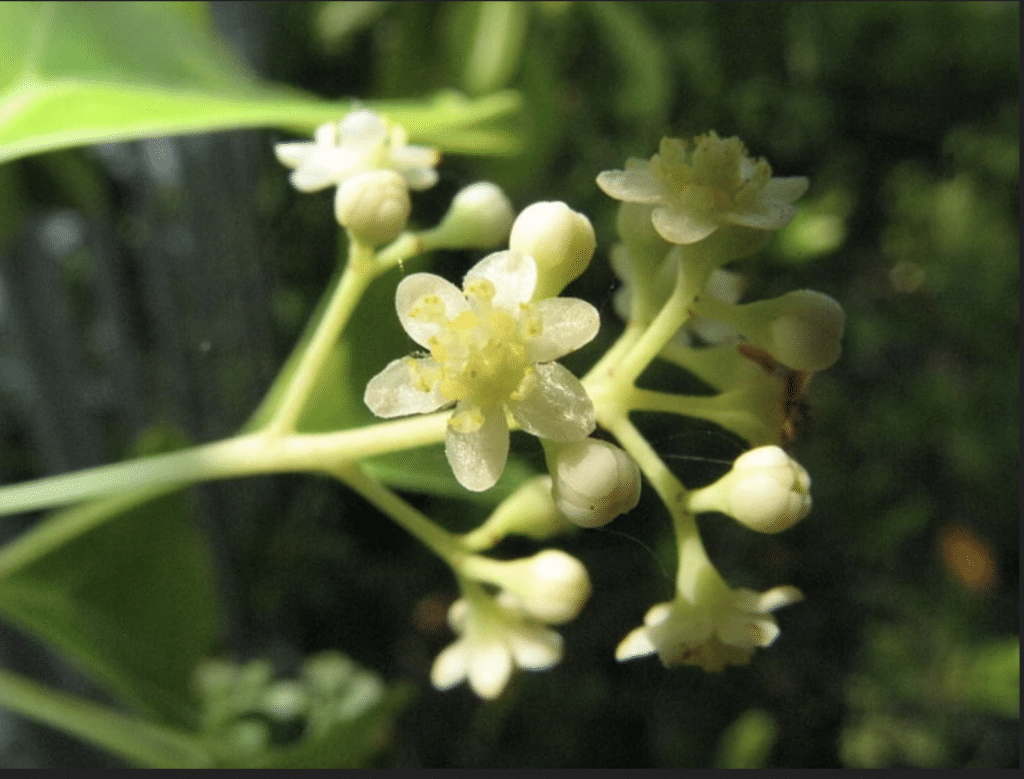
FIGURE 2. ‘Camphor flower’, https://static.wikia.nocookie.net/herbolaria/images/0/05/Cinnamomum_camphora.jpg/revision/latest?cb=20081104152818.
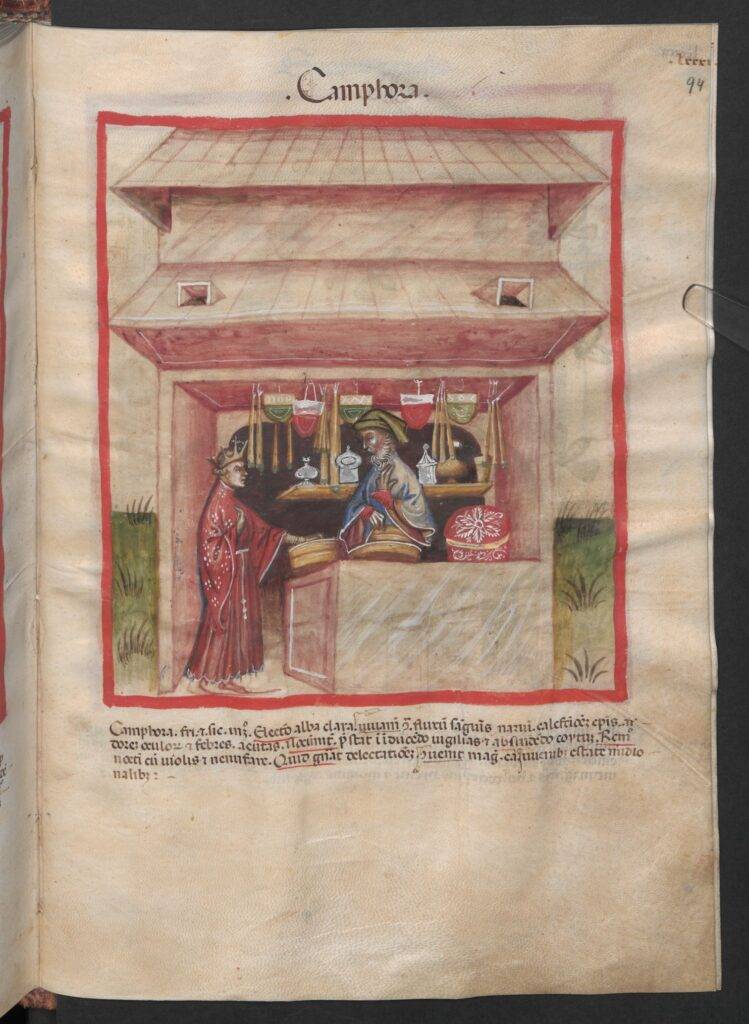
FIGURE 3a. ‘Camphora’, pharmacist (boticario) selling crystals of camphor, in Ibn-Buṭlān, al-Muḫtār Ibn-al-Ḥasan, -1069, Tacuinum Sanitatis, ca. 1380-1399, Österreichische Nationalbibliothek, ÖNB, Vienna, Cod. Ser. n. 2644 HAN MAG, fol. 95, scan 191, https://viewer.onb.ac.at/10020524.
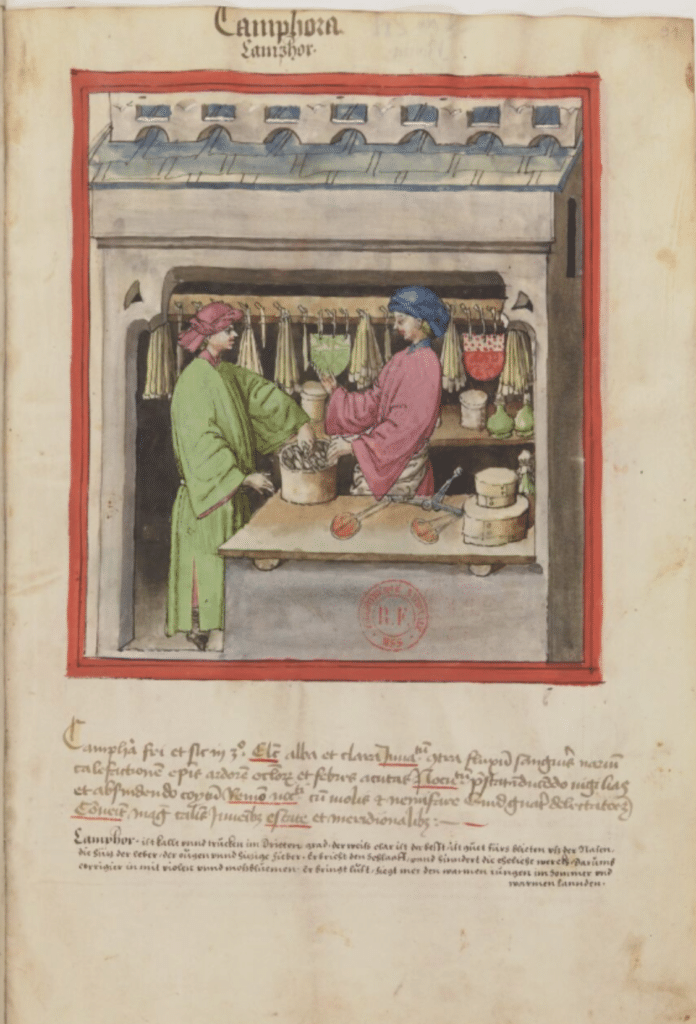
FIGURE 3b. ‘Camphora. Camphor’, pharmacist (boticario) selling crystals of camphor’, in Ibn-Buṭlān, al-Muḫtār Ibn-al-Ḥasan, -1069, Tacuinum Sanitatis, Bibliothèque Nationale de France, BNF NAL 1673, fol. 91r, https://gallica.bnf.fr/ark:/12148/btv1b105072169/f197.item.
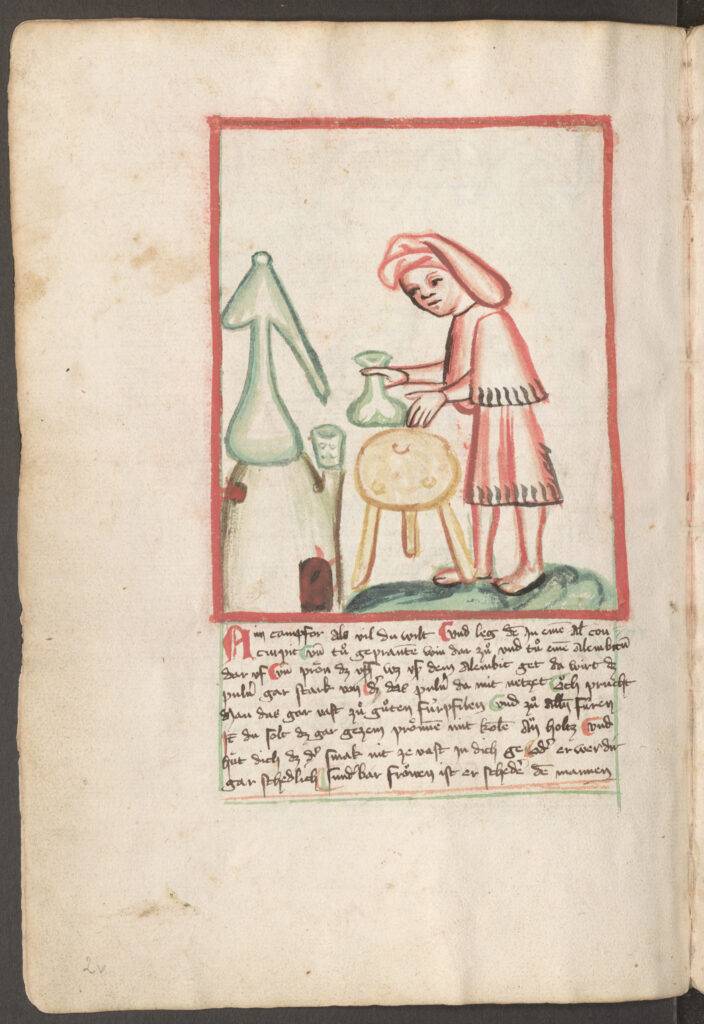
FIGURE 4. “A man with an alembic presumably filled with camphor and spirits”, in Büchsenmeisterbuch von Unbekannt, 1411, Österreichische Nationalbibliothek, ÖNB, Vienna, Cod. 3069 HAN MAG, fol. 2v, scan 15, https://viewer.onb.ac.at/1324F50B.
Memoir on Camphor (‘Memoria sobre el alcanfor’, Manila, 20 January 1790) [1]“Memoria sobre el alcanfor”, AGI, Indiferente 1545, N. 2, fol. 1r (20 January 1790).
Since camphor is one of the principal and most notable commodities, which the Royal Company of the Philippines [Real Companía de Filipinas] has recommended to me as a profitable branch of trade, I have given it my utmost attention ever since I arrived in Manila, and have been able to gain some knowledge of these regions; this is partly because the Dutch are the only ones in Europe who have reported the extent to which this product of nature—unique in its characteristics and possessing such useful properties—is traded, and partly because I have deemed it one of the most worthy of attention, and that it is worth investigating whether the tree grows on these islands, which provide [camphor] in greater abundance than various other aromatic plants, which, according to some learned observers, also contain this substance.
This tree is well known to botanists* [2]*Laurus Camphora Linn: 5p. Plant. pag. 528. and is abundant in the western part of Japan and on other neighbouring islands, from where the Chinese transport large quantities of impure camphor, and the Dutch purchase it to take it to Europe, purify it in the laboratories they have set up for this purpose, and then distribute it through the trade, which they conduct almost exclusively in this drug.
The Chinese also often bring considerable quantities to this capital [that is, Manila], and have sold it at very low prices, such as 16, 18, or 20 pesos per Pico (a). [3](a) Pesa q.e contiene ciento treinta, y siete libras, y media Castellana. The Moors of Jolo and from other parts, who used to come to this port annually, bring small quantities of camphor which is held in much higher esteem and commands a higher price than that of the Chinese. This leads me to believe it is of the most prized quality, which in India is known to be that of (1v) Borneo, Sumatra and other parts of Asia, extracted, according to some, from a different and rarer plant than the one that is said to abound in China and Japan. And it can be reasonably argued that this plant, or Laurus Camphora, also grows in the Philippine Islands, just as Laurus Cassia and Laurus Cinnamomum trees, which belong to the same family, or rather the same genus: but as it is not easy to make discoveries of this nature without them necessarily being carried out by naturalist explorers over several seasons, and at great expense during the repeated and arduous journeys they must undertake without much restriction on their resources, I shall not dwell on this matter in order to report whatever might occur.
I have taken note that the explorations I am to undertake on these islands as part of the Royal Philippine Company’s remit are subject to the decisions of its Governing Board; nor should its members doubt the necessity of such tasks for the discovery of things unknown to the natives of the country, even though positive results are not always apparent within such a short space of time as the interested parties would wish. It is also well known that, although explorers generally do not succeed in discovering specific objects in each expedition, their journeys are nevertheless not in vain. And on this matter I have set out what I have deemed appropriate.
In the letter which a missionary of the Society of Jesus wrote in Peking on 8 October 1736 to Father Duhalde of the same Society and which is included in volume 22 of the Edifying Letters [Lettres édifiantes], [4]This refers to a letter the French Jesuit priest François Xavier d’Entrecolles (1664–1741), who left us a detailed description of camphor, including the extraction and hydro distillation … Continue reading the method is explained which seems to be used in China to extract camphor from the tree known in that Empire by the name Tchang [i.e. zhang 樟], of which I have requested live plants and seeds to ascertain whether it is the one known to modern botanists as Laurus Camphora. I shall not dwell here on the details of the operations he describes for extracting camphor, both because this tree does not grow in Spain, and [because] the digression would serve no purpose other than to satisfy the curiosity of those who have not read the aforementioned letter, and also because, if I manage to discover the tree in question on these islands, I shall apply the knowledge I have already acquired to extract that substance, simplifying the relevant processes as much as possible, and I shall then publish the results of my work.
On this basis, I would say that, although it would be of great benefit to the public and to the Royal Company to discover these plants on these islands, it would also be beneficial to make use of the camphor already extracted by purchasing the camphor that is being sold in China, as the Dutch do; I suppose they [i.e. the Dutch] cannot have better resources in that Empire than those the Royal Company has through its agents in Canton, instructing them that, before accepting any consignment of this kind, they should ascertain whether it is adulterated, in accordance with the instructions already provided on the matter.
Assuming that this merchandise is purchased at fair prices and dispatched to this capital at the same time as other consignments are transported, and that purchases are also made in Manila should the Chinese bring in any consignments as they have done hitherto, it may be disposed of in two different ways: One option would be to dispatch to Spain a quantity, as and when it is purchased from the Chinese established here, provided it is found to be free from adulteration or excessive impurities. Sent in this manner, it could be sold in Spain at a very low price compared to that at which the purified version is commonly sold by the Dutch; and it seems to me it would be accepted by some apothecaries once they are aware of it, both because its price would attract a great deal of attention, and also because it is not strictly necessary for camphor to be purified at all times, provided it is not intended for internal administration. And it need only be dissolved in a suitable liquid in which the resinous substance dissolves, leaving behind any granules or foreign matter that may have been added, in addition to the method which apothecaries will employ to purify camphor themselves whilst practising their profession.
The other method, which will certainly be useful to the Royal Company, is to send it purified as the commodity already known in trade, as presented by the Dutch, who, taking advantage in a certain way of the negligence of other nations, have managed to create the belief that they alone possess the best method of purifying it. This is the view expressed in their works by some of the most meticulous and knowledgeable naturalists and chemists (a), [5](a) El Abate Rocier en su Dicc.o de Agricultura, El S.or de Bomaré en el de Hist.a nat.l y el celebre Bergio en su Mat.a Medica. This refers to Curso completo o Diccionario universal de agricultura … Continue reading none of whom can ascertain which is the true method used by the Dutch, and they merely infer that it is that of sublimation, having seen in some of the Dutch laboratories or camphor refineries vessels and apparatus suitable for such an operation; I, however, wish to purify the camphor, given that I am in a country where it can be obtained almost directly from the source Moreover, if I were to succeed in finding the best method, the Royal Company might benefit from the profits that could be derived from purifying the camphor, and by arranging for it to be introduced into its trade in the same way that the Dutch handle it, and to ensure its circulation, so that the Management of the Royal Company can arrange for two loads of camphor being brought from Canton, which (fol. 6) are commonly sold in that Empire; and having verified that it was not adulterated by being dissolved in wine spirit, I poured it into one of two small glass carafes (b), [6]A glass or carafe with a neck, commonly used for cooling water or serving drinks. which I had brought with me when I came to these Islands among other chemical instruments, eight ounces of the said camphor, mixed with an equal quantity of powdered lime; I covered it with a simple sheet of paper in a sand bath, and by means of a moderate heat I sought to sublimate the said substance; but I had the misfortune that the bottle broke before the operation was complete, whereupon I immediately suspended the fire, and having allowed the bottle to cool, I separated it from the sand with the utmost care and found it shattered but without any piece having come apart; with a little diligence, I separated the pieces of glass and found at the bottom of the bottle eight and a half ounces of almost loose (suelta) material, and four and a half ounces of purified camphor adhering to the upper part and neck of the flask, the greater portion of it gathered whilst retaining the shape of the flask’s neck, and another portion resembling very white flowers, as they appear in the sublimation of ammonium salt and benzoin (venjuí). From this operation, a loss of three ounces could be observed, due both to the amount of impurities that the camphor contained and to the portion that volatilised when the flask broke, the substance of which could be detected through the dense and very penetrating vapours (which emerged) that rose from the sand in which the flask had been placed, leaving a small portion of the camphor itself on the sand as it cooled.
Having no other means of repeating the operation than the glass carafe, and fearing that if it suffered the same misfortune as the other, I would be left with no way whatsoever to complete the operation and to obtain the necessary knowledge on this subject, I decided to set it aside in the hope that it might be needed in an emergency, and I endeavoured to procure another vessel in which, by continuing the experiment, I might discover the method of purifying the said camphor; for this purpose I made use of bottles into which wine is usually placed, and having placed in one of them eight ounces of the same substance with four ounces of lime, a quantity which occupied two-thirds of the bottle, and in another similar bottle eight ounces of the same camphor without any addition, I placed them separately in their respective sand baths. By applying a very moderate heat for a period of four hours, I achieved that the substance in one and the other was sublimated up to the middle of the neck, the sole difference being that in neither of the two did the entire portion of camphor introduced rise completely, a certain amount of camphor remaining at the bottom of both. Having deliberately broken both bottles, I removed from the one containing no added lime five ounces of sublimated camphor, melted into a very thin and transparent mass at the bottom, retaining the shape of the upper part of the bottle; and halfway up the neck, about two fingers’ width, I found the camphor soft, crumbling into a very white powder, and at the bottom of the bottle another portion of camphor, wine-coloured, melted, and formed into a lump, which I could not separate perfectly from the glass, and I made use of it afterwards. During this operation, I calculated, there was a loss of six dragmas, [7]According to Real Academia Española, Diccionario de la lengua española, https://dle.rae.es/dracma, a unit of weight used in pharmacy, equivalent to one-eighth of an ounce, i.e. three scruples or … Continue reading which were undoubtedly destroyed by the fire, and had volatilised from the genuine camphor and the impurities it contained. The camphor in the bottle, to which the lime had been added, rose in the same way, but one portion remained adhering to the upper part of the bottle in the form of white flowers, and another portion lying above the lime bore a striking resemblance to the lightness and brilliance of the flowers of Styrax benzoine (venjuí); having separated this portion of pure camphor, I found six ounces and five and a half of maces at the bottom of the bottle, which was undoubtedly the lime, and a small portion of camphor mixed with the impurities; and for the impurity it exhibited, I could merely notice that half an ounce had been lost during the operation.
Although I was certain that the operations I intended to carry out in the aforementioned bottles would not be sufficient to enable me to purify camphor in large quantities, I undertook them in the hope that they would provide me with some insights that would allow me to get an idea of the most appropriate method [of purifying camphor]. I based myself on the reflections I could make regarding the form in which camphor is introduced into trade by the Dutch, and on the observations I made as a result of the operations I carried out, and truly for no other reason than to observe that the camphor [essence], as it rose, completely filled the opening at the neck of the carafes and bottles, and did not volatilize or decrease in quantity noticeably through the mouths of those vessels; since it had not yet risen to where the simple piece of paper covering it was located, I decided to test what would happen if I carried out the operation with glazed earthenware vessels, since these had a larger capacity and could hold a sufficient quantity of camphor to form a large lump or mass; and I assumed that if they withstood the heat without breaking, they would meet my expectations. Indeed, I looked for a piece (b) of ordinary clay, glazed like the vessels that come from China, and placed in them 16 ounces of the same camphor mixed with four ounces of lime, which served to break the camphor down into small particles, almost powder-like, and I believed it would be sufficient to bind the impurities contained in the camphor, and to prevent the fire from causing the camphor to take on an olive colour as it sublimated. I covered the pot with a fairly deep, ordinary plate (c, a soup plate) placed upside down and sealed the joints with paste (d; made from wheat flour, lime, and plain water), and strips of paper; placed into sand I maintained a steady fire until I noticed that the material was making a sound inside as if it were boiling; I kept the fire at that level for more than four hours, and having observed that the noise had ceased, I turned down the heat.
Then, after the vessels had cooled, I emptied them and found that the sublimated camphor had formed a clear, pure mass, transparent like thin glass, in proportion to the amount of camphor I had used. I easily separated the said camphor from the plate in a large piece, and with greater difficulty that which was adhering to the rim and the walls of the passageway, which lost its transparency upon separation, and having weighed the results, I found four ounces of lime as residue (Caput mortuum) and fourteen ounces of purified camphor, with a loss of two ounces. Some portion of this would be impurity, which the fire would destroy, and the residue would be waste and imperceptibly volatilised.
Having observed that the sublimated camphor could not be improved and that no greater quantity of lime was necessary, I reasoned that by using a double quantity in another process, the mass would be thicker and could perhaps more easily be separated from the vessels due to its greater consistency, leaving the plate-like shape to which it adhered. I proceeded thereafter repeating the same step, taking two pounds of camphor and eight ounces of lime—which had remained from the previous operation without any damage—and, having carried out the operation as I had done previously, succeeded in causing the camphor to rise and adhere to the plate halfway up to the walls of the passageway, forming a cohesive mass, transparent like glass in some parts but somewhat porous on others, and pale in colour, which formed a rim around the edge of the passageway.
Not knowing to what to attribute this discrepancy—since the camphor, which was adhering to the lower part of the inner walls of the bottleneck [passageway] was even more transparent than that on the plate covering it, and the uneven amount was located in the middle of the sublimed material, that is, towards the edge of the passageway, I thought it might be the effect of excessive heat, and that the small amount of lime was insufficient to prevent some sooty vapours from rising, vapours that came from the foreign matter present in the camphor I used. I repeated several operations with varying quantities of lime mixed with the camphor, others with ash instead of lime, and in vessels of various sizes. I will not describe all of these operations, as this would make the writing too tedious, nor the various things I observed. I have come to understand that the purification of camphor is a curious operation, worthy of being carried out by diligent teachers, for only by repeating it several times can one determine the appropriate degree of heat so that the sublimated camphor takes the form of solid loaves or cakes, and not the form of flowers or a light, spongy mass. It is irrelevant whether the added substance is lime, ash, or another absorbent material, as long as the camphor is properly purified. However, even if no substance is added to the camphor, it will still be purified upon rising. The drawback is that, if the heat is continued after all the camphor has risen, it tends to emerge somewhat darker than if it had contained some additive that would have enveloped the impurities. This operation can be performed in earthenware vessels with considerable savings and less risk than in glass vessels, without fear of significant loss, as this will depend solely on the impurities present in the camphor used. And for this reason it is not difficult to purify camphor in the Indies [lit. la India; this should refer to the Philippines or the East Indies in general] in large quantities, as we have been fortune to discover vessels that can replace glass ones, which it would be very costly to have brought over from Europe in sufficient numbers, since in each operation the glass vessel used to separate the purified camphor is indispensably broken, while the clay vessels can be used several times.
In this regard, I cannot help but to point out how useful I have found the method of purifying camphor in earthenware vessels, and that it should not be regarded as such a complicated process as has been believed; for this reason, it seems that until now the Dutch have kept this as a secret of a better method of carrying out this curious and delicate operation, dealing almost exclusively in the trade in this commodity.
To verify the above, some pounds of camphor purified in Manila are being sent by the frigates of the Royal Company Rey Carlos and [Nuestra Señora de los] Placeres, which are returning to Cádiz this year; the shape of which demonstrates the vessels in which the operations have been carried out. And I must assure you that by manufacturing vessels expressly of the shape required, and by making ovens or furnaces of suitable proportions, the operations will be carried out in much larger quantities, with far greater efficiency than I have practised thus far.
Manila 20th January 1790
References
| ↑1 | “Memoria sobre el alcanfor”, AGI, Indiferente 1545, N. 2, fol. 1r (20 January 1790). |
|---|---|
| ↑2 | *Laurus Camphora Linn: 5p. Plant. pag. 528. |
| ↑3 | (a) Pesa q.e contiene ciento treinta, y siete libras, y media Castellana. |
| ↑4 | This refers to a letter the French Jesuit priest François Xavier d’Entrecolles (1664–1741), who left us a detailed description of camphor, including the extraction and hydro distillation process, wrote to Jean-Baptiste Du Halde (1674–1743). It has been published in the annual reports of the Jesuit missionaries known as the Lettres édifiantes et curieuses de Chine par des missionnaires jésuites (1702–76). The information, according to him, stems from a “recently published book”, composed on the order of the Kangxi Emperor (r. 1662–1722). The camphor stems from a tree called ‘tschang’ in Chinese, Cinnamomum camphora. |
| ↑5 | (a) El Abate Rocier en su Dicc.o de Agricultura, El S.or de Bomaré en el de Hist.a nat.l y el celebre Bergio en su Mat.a Medica. This refers to Curso completo o Diccionario universal de agricultura teórica, práctica, económica, y de medicina rural y veterinaria / escrito en francés por una sociedad de agrónomos y ordenado por el Abate Rozier [Jean-Baptiste François Rozier], traducido al castellano por don Juan Álvarez Guerra (Madrid: Imprenta Real, 1782), https://bibdigital.rjb.csic.es/idurl/1/1772224; Jacques-Christophe Valmont de Bomare (1731–1807), Dictionnaire raisonné universel d’histoire naturelle. Contenant l’histoire des animaux, des végétaux et des minéraux, et celle des corps célestes, des météores, & des autres principaux phénomenes de la nature (Paris: Didot jeune, 1764), https://www.biodiversitylibrary.org/item/314215#page/7/mode/1up; and Peter Jonas Bergius (1730–1790), Materia medica e regno vegetabili, sistens simplicia officinalia, pariter atque culinaria. Secundum systema sexuale, ex autopsia & experientia, fideliter digessit (Stockholm: Hesselberg, 1778), https://www.digitale-sammlungen.de/en/details/bsb10285581 or https://bibdigital.rjb.csic.es/records/item/13845-materia-medica-e-regno-vegetabili-editio-secunda?offset=3. |
| ↑6 | A glass or carafe with a neck, commonly used for cooling water or serving drinks. |
| ↑7 | According to Real Academia Española, Diccionario de la lengua española, https://dle.rae.es/dracma, a unit of weight used in pharmacy, equivalent to one-eighth of an ounce, i.e. three scruples or 3.594 mg. |
The numbering of the following illustrations refers to chapter no. 12, “Some Remarks on the Use and Provision of Camphor in Early Modern China and in Spanish Asian and American Colonies”, in The Crossroads of the Steppe and the Sea, Festschrift dedicated posthumously to Paul D. Buell (1941–2026), edited by Timothy May (Leiden, Boston: Brill Publishers, forthcoming), probably pp. 234-268.
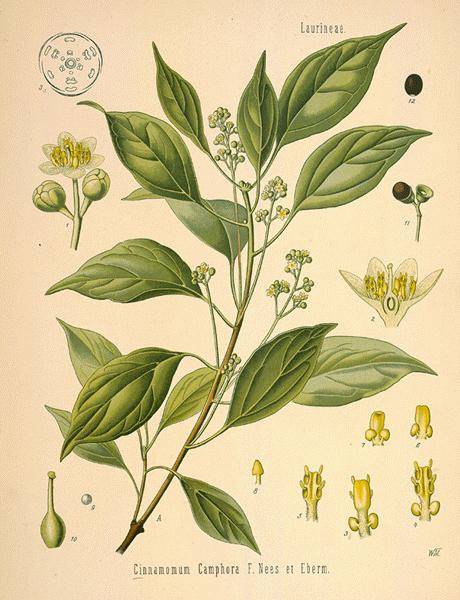
FIGURE 12.1. Cinnamomum camphora
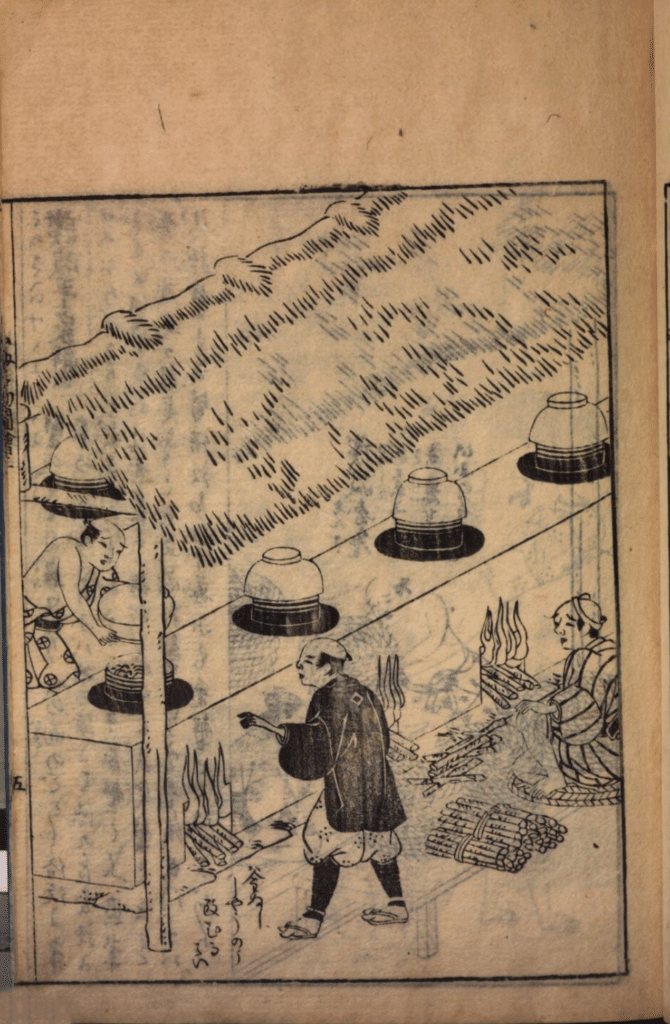
FIGURE 12.1a. Hirase Tessai 平瀬徹齋, Nihon sankai meibutsu zue 日本山海名物圖會 (Ōsaka: Harimaya Kōbē [1797]), Bayerische Staatsbibliothek (BSB), Digitale Sammlungen, Ostasien, online https://ostasien.digitale-sammlungen.de/view/bsb11191583?page=,1, fols. 0114-0115.
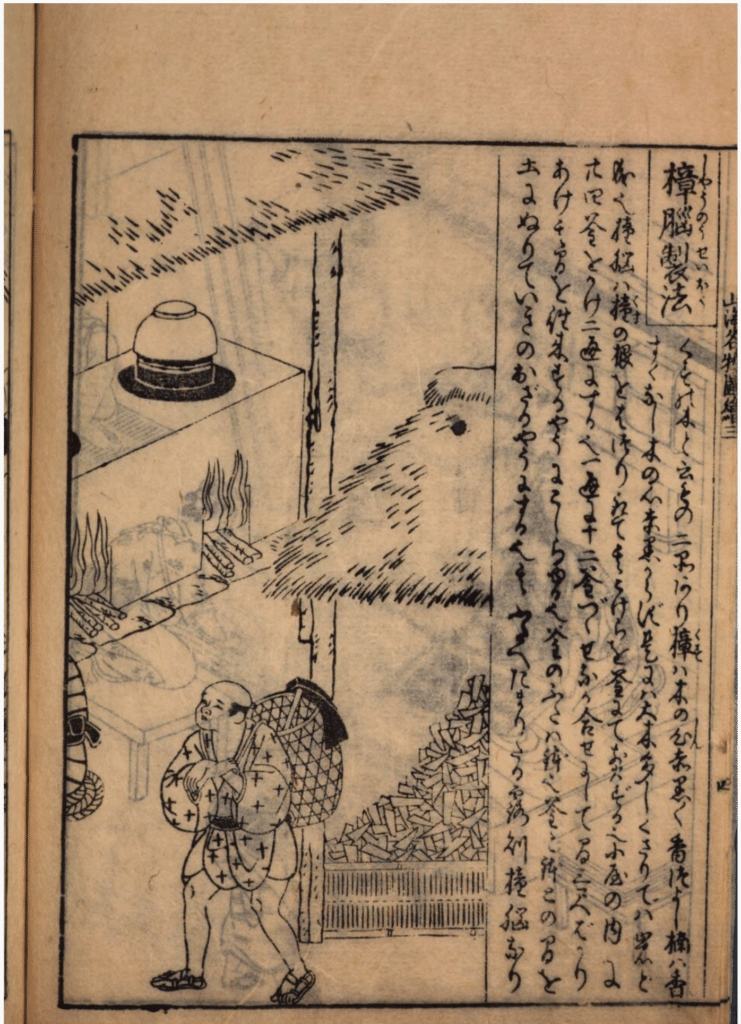
FIGURE 12.1b. Hirase Tessai 平瀬徹齋, Nihon sankai meibutsu zue 日本山海名物圖會 (Ōsaka: Harimaya Kōbē [1797]), Bayerische Staatsbibliothek (BSB), Digitale Sammlungen, Ostasien, online https://ostasien.digitale-sammlungen.de/view/bsb11191583?page=,1, fols. 0114-0115.
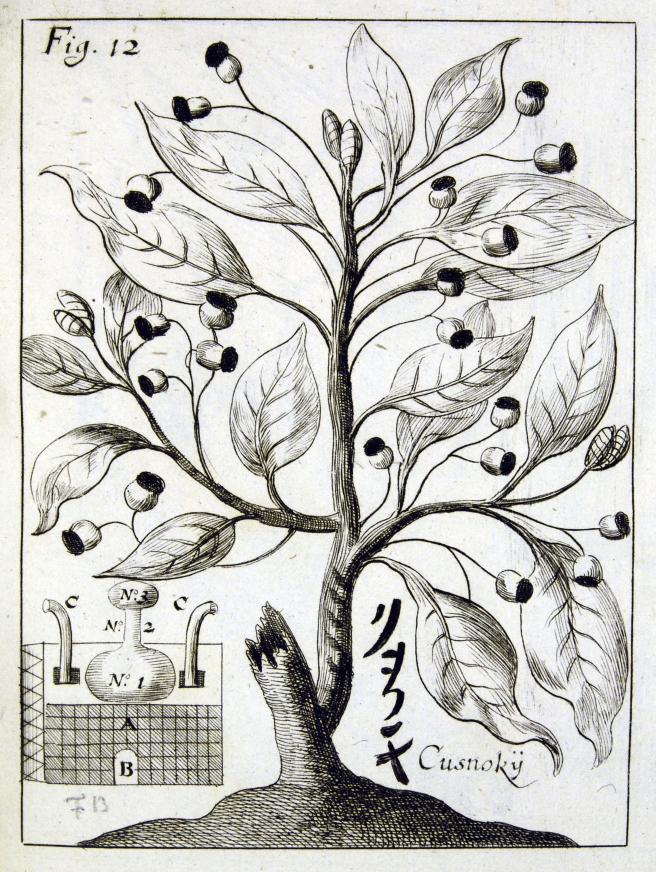
FIGURE 12.2. Japanese camphor tree (kusunoki) and a distillation apparatus to produce camphor depicted in Andreas Cleyer’s ‘Observatio de Arbore Camphorifera Japonensium Kusnoky dicta’ (1692) (Miscellanea curiosa medico-physica, Decuria II, Annus X. Personal collection of Wolfgang Michel), Fig. 7 in Wolfgang Michel, ‘On the emancipation of materia medica studies (honzōgaku) in early modern Japan’ 近世日本における本草学の自立について, in Zhang Tao et al. (eds.), Proceedings of the 5th International Symposium on the History of Indigenous Knowledge (ISHIK 2015), 93-106, 103 (with courtesy of the author).
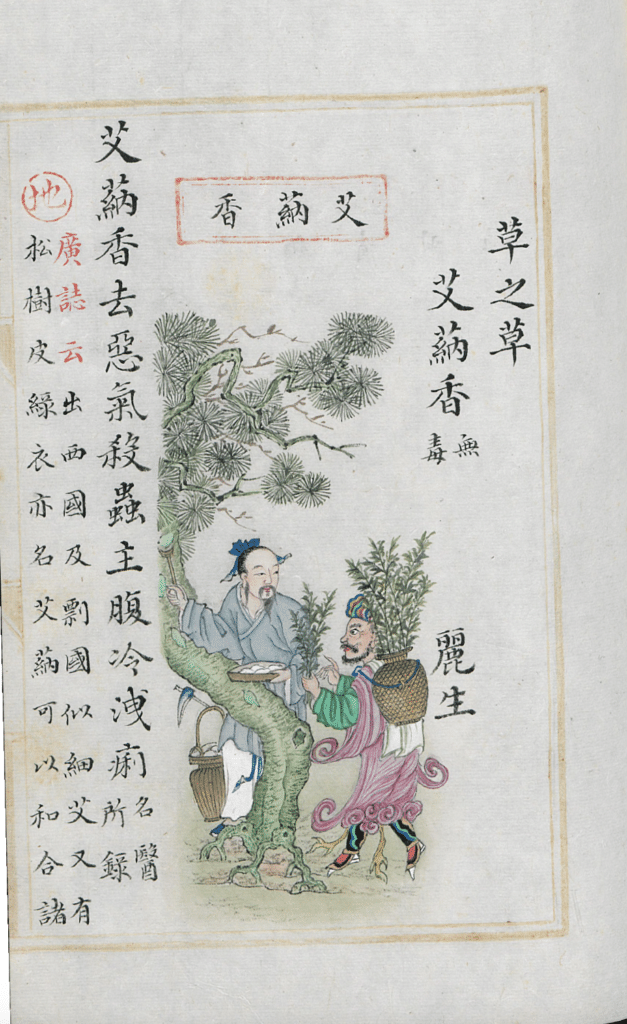
FIGURE 12.3. Ngai camphor or “sambong”, in Chinese “aina xiang” 艾納香 or “dafengai” 大風艾, in Bencao pinhui jingyao 本草品彙精要 (Materia Medica. Containing Essential and Important Material Arranged in Systematic Order), compiled under the supervision of Zhang Yu 張瑜 and Liu Wentai 劉文泰 (fl. 1488–1505), juan 12, no pagination, downloaded from https://stabikat.de/Record/3346157326 (accessed on September 25, 2020).
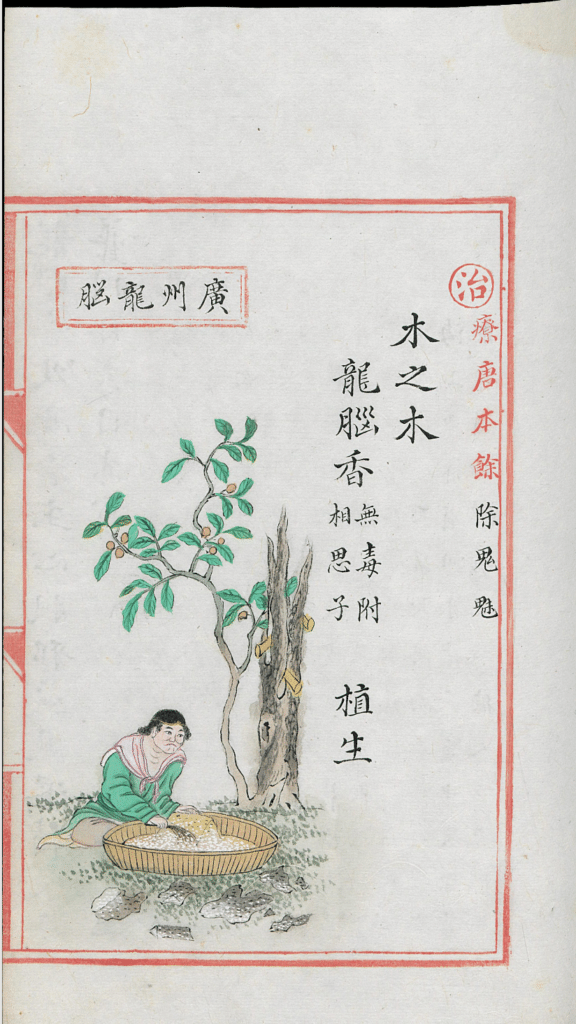
FIGURE 12.4a. “Guangzhou longnao” 廣州龍腦, longnao xiang 龍腦香 (Dryobalanops aromatica C. F. Gaertn.; borneol), in Bencao pinhui jingyao 本草品彙精要, juan 17, no pagination, downloaded from https://stabikat.de/Record/3346157326 (accessed on September 25, 2020).
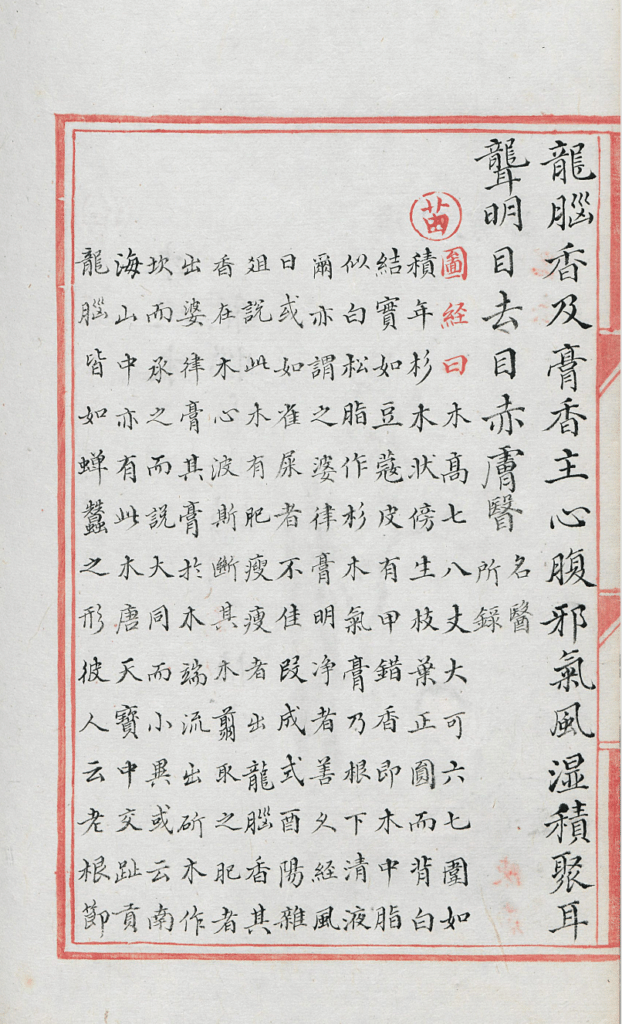
FIGURE 12.4b. “Guangzhou longnao” 廣州龍腦, longnao xiang 龍腦香 (Dryobalanops aromatica C. F. Gaertn.; borneol), in Bencao pinhui jingyao 本草品彙精要, juan 17, no pagination, downloaded from https://stabikat.de/Record/3346157326 (accessed on September 25, 2020).
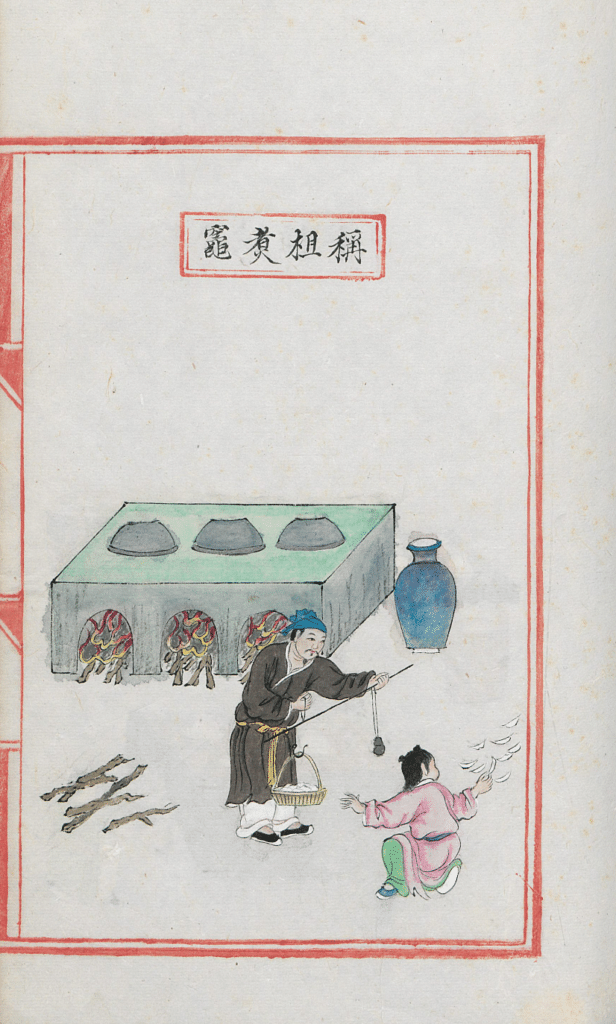
FIGURE 12.5a. “Chengzha zhuzao” 稱柤煑竈 (Weighing and lighting the fire), in Bencao pinhui jingyao 本草品彙精要, juan 17, no pagination, downloaded from https://stabikat.de/Record/3346157326 (accessed on September 25, 2020).
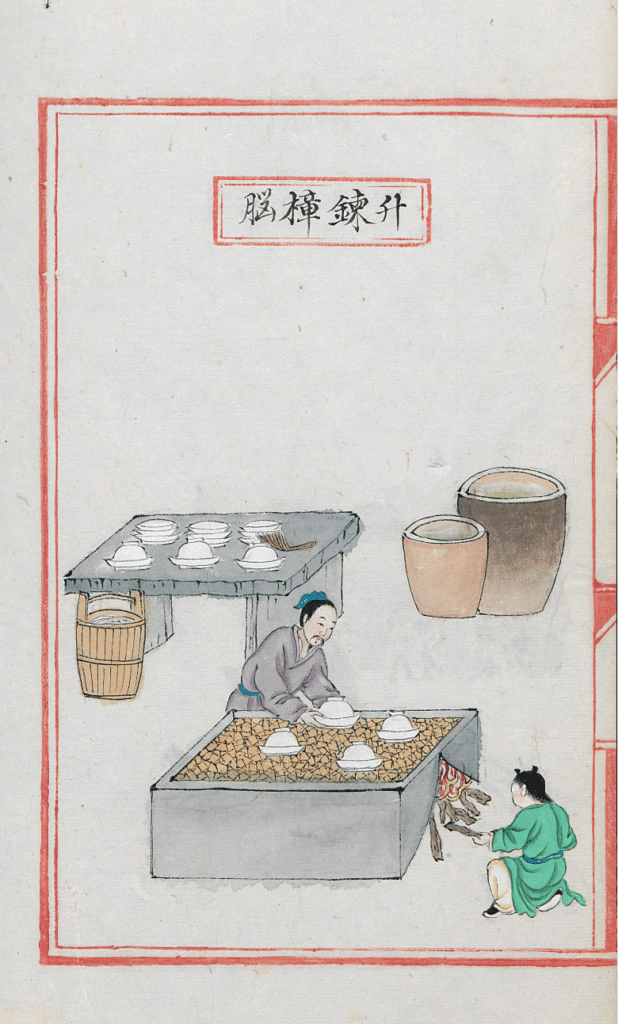
FIGURE 12.5b. “Shenglian zhangnao” 升楝[煉]樟腦 (Sublimation of camphor) [1]The camphor wood was sliced, soaked in water, and then placed in a pot to be heated and simmered. The camphor would rise with the water vapour; upon coming into contact with the earthenware jar … Continue reading, in Bencao pinhui jingyao 本草品彙精要, juan 17, no pagination, downloaded from https://stabikat.de/Record/3346157326 (accessed on September 25, 2020).
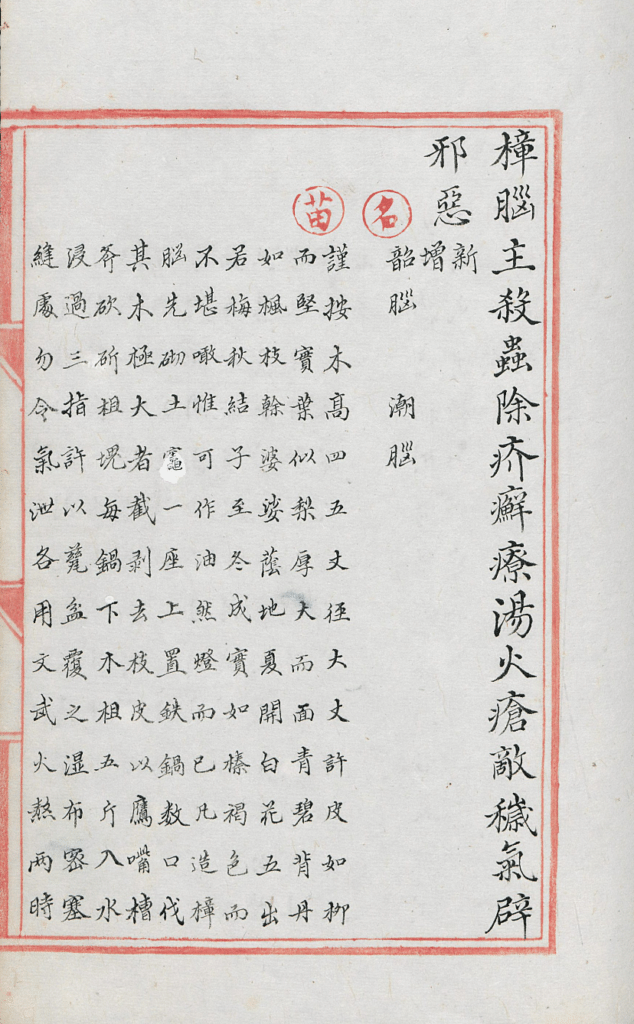
FIGURE 12.5c. Description of “zhangnao” 樟腦, in Bencao pinhui jingyao 本草品彙精要, juan 17, no pagination, downloaded from https://stabikat.de/Record/3346157326 (accessed on September 25, 2020).
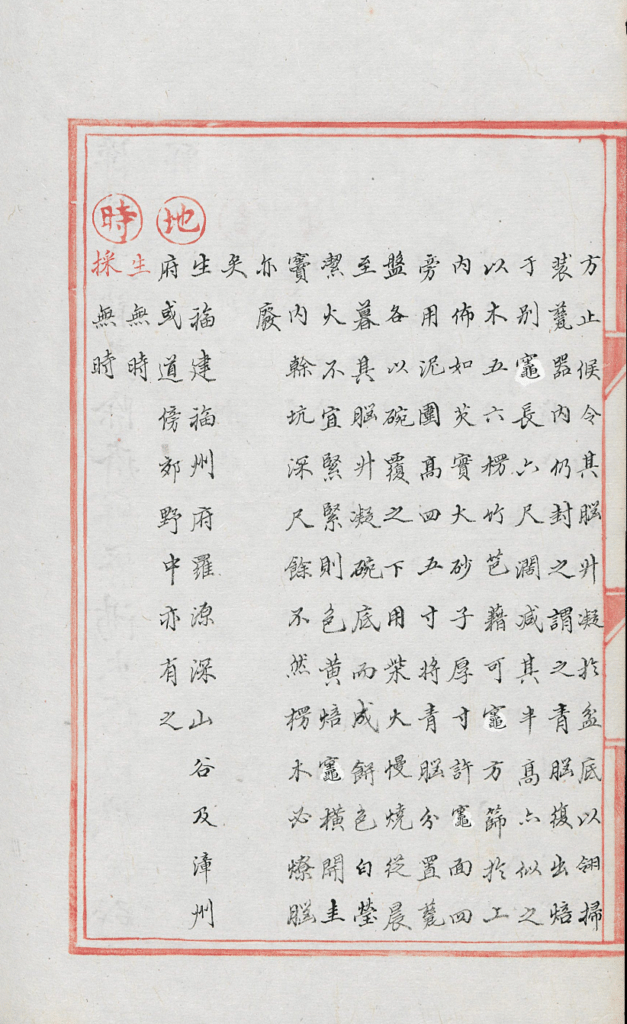
FIGURE 12.5d. Description of “zhangnao” 樟腦, in Bencao pinhui jingyao 本草品彙精要, juan 17, no pagination, downloaded from https://stabikat.de/Record/3346157326 (accessed on September 25, 2020).
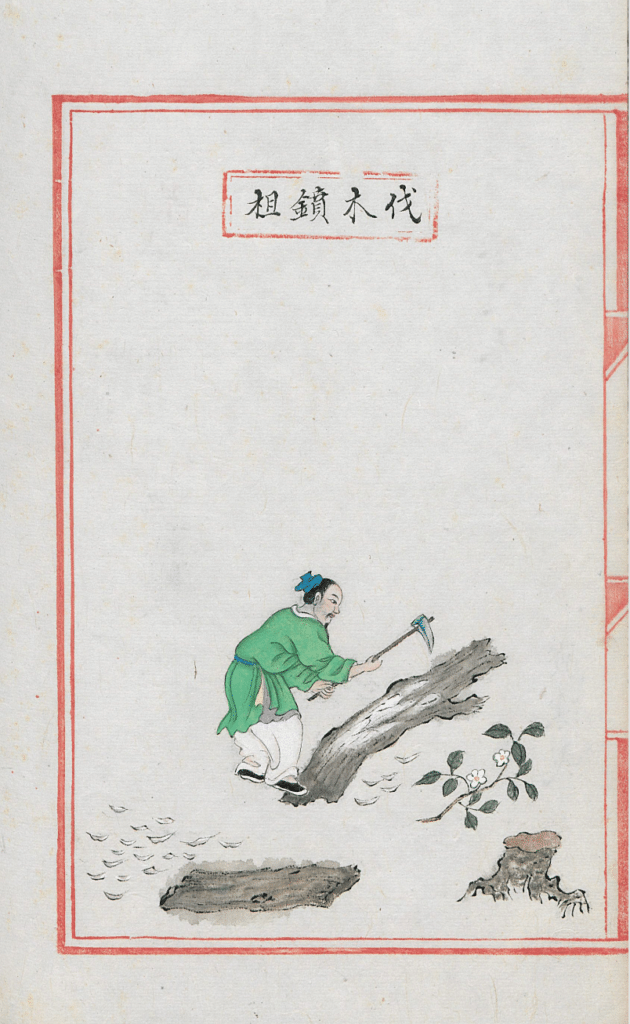
FIGURE 12.5e. “Famu fenzha” 伐木鐼柤 (Chopping wood with a log-cutting axe), Bencao pinhui jingyao 本草品彙精要, juan 17, no pagination, downloaded from https://stabikat.de/Record/3346157326 (accessed on September 25, 2020).
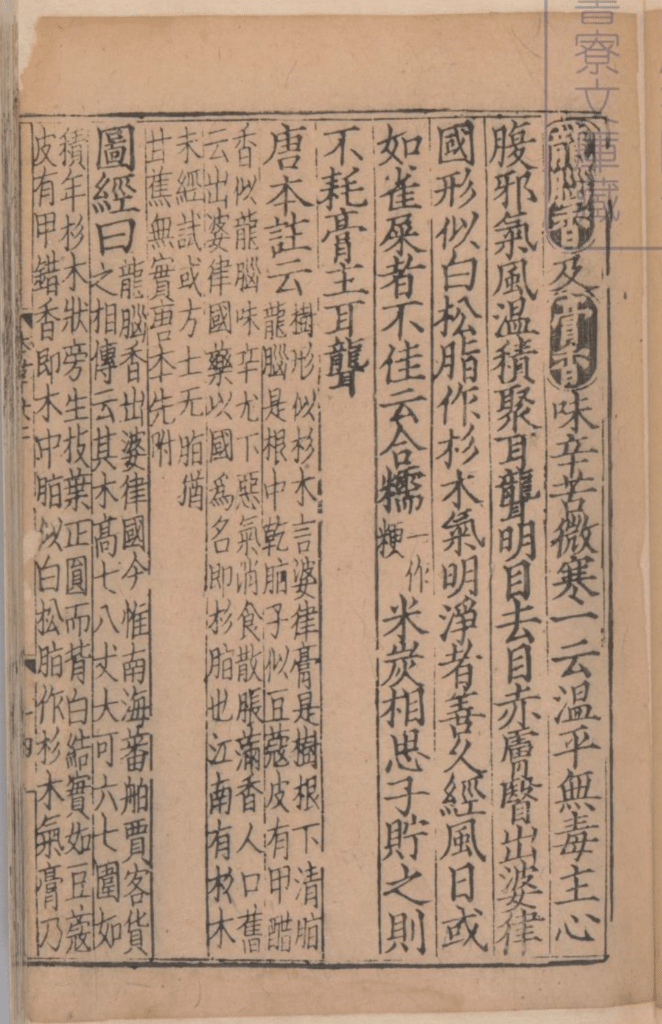
FIGURE 12.6a. Xinxiu bencao 新修本草, by Su Jing 蘇敬, also named Su Gong 蘇恭 (599–674), in Tang Shenwei 唐慎微 (ed.), Xinbian leiyao tuzhu bencao 新編類藥圖注本草 22, vol. 13, 16 (13b), Manuscript, Imperial Household Agency: Archives and Mausolea Department, http://db.sido.keio.ac.jp/kanseki/T_bib_frame.php?id=006900 (accessed on September 25, 2020).
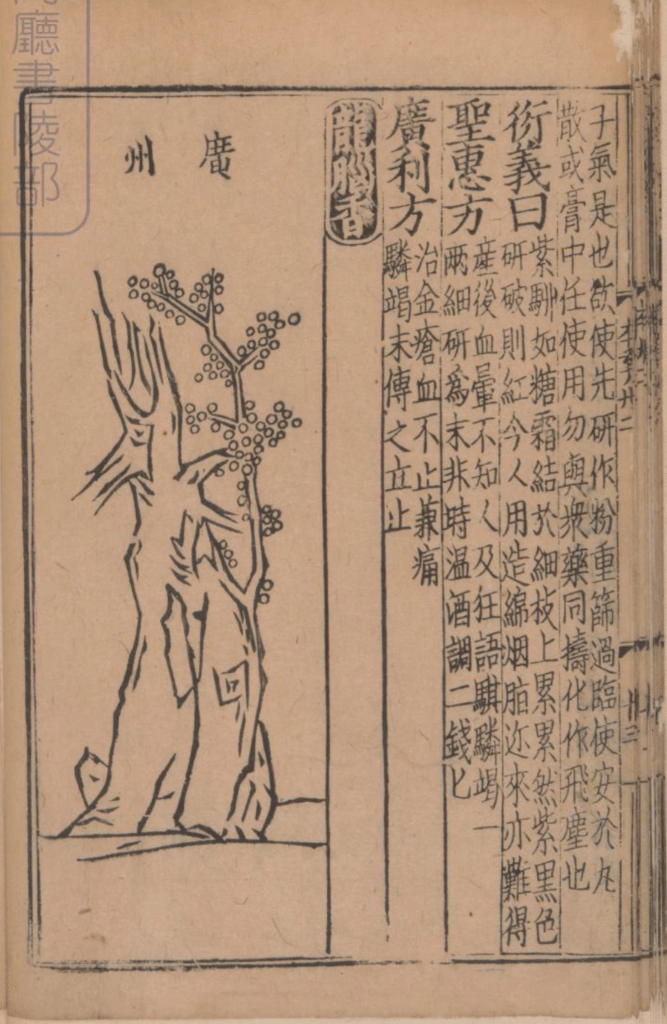
FIGURE 12.6b. Xinxiu bencao 新修本草, in Xinbian leiyao tuzhu bencao 22, vol. 13, 16 (14a).
References
| ↑1 | The camphor wood was sliced, soaked in water, and then placed in a pot to be heated and simmered. The camphor would rise with the water vapour; upon coming into contact with the earthenware jar covering the pot, it would cool and condense into ‘snow-white’ solid crystals. This process was known as ‘sublimation’ (shenglian 升煉). |
|---|
Siendo el alcanfor uno de los principales y señalados objetos, q.e como ramo util de comercio me ha recomendado la R.l Comp.a de Filipinas le he considerado con la maior atencion, desde, q.e llegué a Manila, y pude tomar algun conocimiento de estas Regiones asi porque los Holandeses son los unicos, q.e en Europa han dado la extensión, q.e tiene en el comercio dicha produccion de la naturaleza singular en sus accidentes, y de tan utiles propiedades, como tambien porque la he creydo de las mas atendibles, y q.e merece indagar si en estas Islas vejeta el arbol, q.e la subministra con mas abundancias entre otras varias plantas aromaticas, q.e segun algunos sabios observadores participan de dicha sustancia.
Dicho arbol está conocido de los Botanicos* [1]*Laurus Camphora Linn: 5 p. Plant pag. 528. y abunda en la parte occidental del Japon, y en otras Islas vecinas de donde los Chinos conducen grandes cantidades de alcanfor impuro, y compran los Holandeses p.a llevarlo à Europa purificarlo en los laboratorios, q.e tienen echos al intento, y distribuirlo despues en el comercio, q.e hacen casi esclusivo de esta droga.
Tambien suelen traer los Chinos à esta Capital cantidades considerables, y han bendido a precios mui bajos como lo son de 16, 18, a 20 pesos cada Pico (a). Los Moros de Jolo, y de otras partes, q.e annualmte suelen venir à este puerto traen algunas pequeñas porciones de alcanfor al qual se da mucha mas estimacion, y precio, que al de los Chinos, y me hace creer sea de la calidad mas apreciada, q.e en la India se conoce como lo es el de (fol. 1v) Borneo, Sumatra, y otras partes en la Asia extrahido segun opinion de algunos de planta diferente, y mas rara, q.e la q.e dicen abunda en China y en el Japon, y puede reselarse con bastante fundamto, q.e en las Islas Filipinas vejeta tambien esta planta, o el Laurus Camphora del mismo modo, que se hallan el Laurus Cassia arboles, que son de la misma familia, o sea del mismo genero: pero como no es facil hacer descubrimtos de esta naturaleza sin q.e se consuman indispensablem.te por los exploradores naturalistas algunas temporadas, y caudales en las repetidas y penosas peregrinaciones, q.e deben hacer sin mucha restriccion de facultades no me dilataré sobre este asunto p.a informar lo q.e pudiera ocurrirme acerca de el; hecho cargo, q.e las exploraciones, que yo hubiere de hacer en estas islas como naturaleza de la R.l comp.a de Filipinas penden de las determinaciones de su Junta de Govierno sin que puedan dudar los que la componen lo necesarias, que son semejantes tareas p.a el descubrimto. de las cosas no conocidas de los naturales del pais no lograndose percibir a veces los buenos sucesos en tan breve tpo. como apetecen los interesados siendo tambien mui notorio, q.e aunq.e los esploradores en general no consigan descubrir objeto señalado en cada salida nunca son inutiles sus peregrinaciones, y sobre el asunto tengo representado lo q.e me ha parecido conveniente.
En la carta, q.e un misionero de la comp.a de Jesus escrivio en Pekin à 8 del Octubre de año de 1736, al P.e Duhalde de la misma Comp.a y está inserta en el tomo 22 de las Cartas Edificantes se halla explicado el metodo, q.e parece uzan en la China para extraher el alcanfor del arbol conocido en aquel Imperio por el nombre Tchang del qual tengo pedidas (fol. 2r) plantas vivas, semilla p.a asegurarme si es el q.e conocen los botanicos modernos por Laurus Camphora, y no me detengo en referir aquí el por menor de operaciones, q.e expone p.a extraher el alcanfor asi porq.e no vejetando este arbol en España no serviría la digresion de otra cosa, q.e satisfacer la curiosidad del q.e no hubiere leydo la citada carta, como tambien porq.e si consigo descubrir en estas islas el referido arbol me dedicaré con los conocimtos, q.e ya tengo adquiridos a extraher dicha substancia simplificando, quanto me sea posible las conducentes operaciones, y manifestaré entonces los resultados de mis tareas.
Bajo de este supuesto digo: Que aunq.e sería muy util al Publico, y a la R.l Comp.a hacer el descubrimto. de dichos vejetales en estas islas tambien lo sería aprovechar el ramo de alcanfor ya extrahido haciendo las compras del q.e venden en China segun executan los Holandeses quienes supongo no deben tener en aquel Imperio mejores medios, que los q.e tiene la R.l Comp.a por sus Factores en Canton previniendo à estos, q.e antes de admitir partida alguna de dicho genero reconoscan si esta adulterado arreglandose a las prevenciones, que se las tiene ya echas sobre el asunto.
Supuesta la compra de este genero a precios equitativos, y su remision à esta Capital al mismo tpo. q.e se conducen otros, y comprando tambien en Manila si los Chinos traxesen algunas partidas como han echo hasta aora puede darsele salida de dos modos diferentes: Uno sera remitiendo á España alguna cantidad según se compra a los Chinos reconocido aqui si se halla sin adulterio, ni impuridad demasiada. Embiado de este modo podra venderse en España á precio mui bajo respecto de el à que comunmente se vende el purificado por los Holandeses, y me parece (fol. 2v) seria admitida de algunos boticarios luego, q.e tubiesen conocimto. de el así porq.e su precio llamaría mucho la atencion, como tambien porq.e no es de presisa necesidad, q.e el alcanfor este purificado siempre, q.e no sea p.a administrarlo interiormte, y solamte. se haya de disolver en algun licor apropriado en el qual se disuelve la sustancia resinosa dejando libre qualquiera paxilla, o cuerpo estraño, q.e haya tenido agregado ademas de la proporcion, q.e tendran los boticarios, p.a purificar por si el alcanfor exercitandose en su profesion.
El otro modo, q.e seguram.te será util a la R.l comp.a es embiarle purificado como genero ya conocido en el comercio segun se presenta por los holandeses los quales aprovechandose en cierto modo de los descuidos de las demas naciones han logrado que se crea q.e ellos son los q.e paseen solamt.e el mejor metodo de purificarlo así lo sientan en sus obras algunos de las mas exactos, é instruidos naturalistas, y chimicos (a) [2](a) El abate Rocier en su Dicc.o de Agricultura, El S.or de Bomaré en el de Hist.a nat.l y el celebre Bergio en su Mat.a Medica. no llegando a asegurar ninguno qual sea el verdadero metodo, q.e usan los Holandeses, y solamente infieren es el de la sublimacion por haver visto en alguno de los laboratorios, o refinadurias de alcanfor de los holandeses vasijas, y aparejos proprios de dicha operación; pero desexo yo de purificar el alcanfor respecto de hallarme en el pais donde se podia adquirir casi de primera mano, y de que si conseguia acertar con el mejor metodo la R.l Comp.a se aprovechase de las utilidades, q.e pueden resultarla de el alcanfor purificandolo, y disponiendolo p.a introducirlo en su comercio del mismo modo, q.e los Holandeses lo acomodan, y hacen circular proporcione, q.e la Direccion de la R.l Comp.a hiciese conducir de Canton dos picos de alcanfor, q.e (fol. 3r) comunm.te venden en aquel Imperio, y haviendo reconocido, que no estaba adulterado mediante la disolución en Espiritu de vino puse dentro de una de dos garrafas de vidrio pequeñas (b) [3]Vaso con cuello comunm.te destinado p.a enfriar agua o tras bebidas. q.e quando vine à estas Islas traje entre otros instrumento.s chimicos ocho onzas del referido alcanfor unido a igual cantidad de cal hecha polvo la coloque tapada con un simple papel en baños de arena, y mediante un fuego graduado solicité la sublimacion de dicha substancia pero tube la desgracia de q.e se rompiese la garrafa antes de concluir la operación por la qual inmediatam.te suspendí el fuego, y haviendo dejado enfriar la garrafa la separe de la arena con el maior cuidado y la halle vajada pero sin desunirse pedaso alguno, a poca diligencia, q.e hice desuni los pedasos de vidrio y halle en el fondo de la garrafa ocho onzas, y media de materia casi suelta, y quatro onzas, y media de alcanfor purificado aderido à la parte superior y cuello de la garrafa la maior porcion de el reunido guardando la figura del cuello de la garrafa, y otra porcion à semejanza de flores mui blancas segun resultan en la sublimacion de sal amoniaco y del venjuí. De esta operacion se advierte la disminucion de tres onzas ya sea por la cantidad de impuridades, q.e tendria el alcanfor, y ya por la q.e se volatilizo por haverse rota la garrafa cuya substancia se dejo percibir por medio de los vapores densos, y mui penetrantes (q.e salian) q.e salian de la arena en q.e estaba colocada la garrafa haviendose quedado alguna pequeña porcion del alcanfor concreto sobre la arena quando fue enfriando.
No hallandome con otro recurso p.a repetir la (fol. 3v) operación, q.e el de la garrafa de vidrio, y temiendo q.e si padecía igual desgracia, q.e la otra quedaba sin medio alguno p.a apurar la operacion, y tomar los presisos conocimt.os acerca de esta materia determiné reservarla como por esperanza en la maior necesidad, y cabilé p.a proporcionar otras vasijas en q.e pudiese continuando los experimtos. acertar con el metodo de purificar dicho alcanfo, a este intento me vali de la botellas, en q.e regularm.te se pone el vino y haviendo colocado dentro de una de ellas ocho onzas del mismo genero con quatro onzas de cal cantidad, q.e ocupó las dos terceras partes de la botella y en otra igual botella ocho onzas del mismo alcanfor sin adicion alguna las coloqué con separacion en sus respectivos baño de arena, y dandolas el fuego mui graduado por espacio de quatro horas consequí, q.e la sustancia de una, y otra botella sublimase hasta la mitad del cuello con sola la diferencia de q.e en ninguna de las dos acabo de asender toda la porcion de alcanfor; que se introdujo, y quedó en el fondo de una, y otra alguna cantidad de alcanfor, y haviendo quebrado exprofeso las dos botellas saque de la que no tenia adicion de cal cinco onzas de alcanfor sublimado, y fundido en pedaso mui delgado y trasparente por la parte inferior conservando la figura de la superior de la botella, y a la mitad del cuello como el largo de dos dedos halle el alcanfor blando, q.e se desmenuzaba en polvo mui blanco, y en el fondo de la botella otra porcion de alcanfor de color vinoso, fundido, y hecho un pedaso, q.e no pude separar perfectam.te del vidrio, y aproveché posteriom.te. En esta operacion calculo tubo la disminución de seis dragmas, q.e sin duda se destruyeron, y volatilizaron por el fuego (fol. 4r) ya del verdadero alcanfor, y ya de la impuridad q.e contenia. El alcanfor de la botella, en q.e estaba agregada la cal ascendio igualm.te pero se quedó adherido una porcion a la parte superior de la botella en forma de flores blancas, y otra porcion encima de la cal, q.e representaban con mucho semejanza à la figura ligera, y brillo q.e tienen las flores de venjuí, y despues de haver separado dicho alcanfor puro halle seis onzas, y cinco y media de maza al fondo de la botella la qual sin duda fue la cal, y alguna pequeña porcion de alcanfor con las impuridades, q.e este tendria de forma, q.e solamte advertí, q.e en la operacion se havia disminuido media onza.
Aunq.e estaba asegurado, q.e las operaciones q.e determine executar en las botellas referidas no serian suficientes para q.e yo pudiese purificar el alcanfor en cantidades crecidas las emprendí esperando en q.e medarian conocimtos. p.a formar alguna idea del metodo mas adequado respecto de las reflexiones, que podia hacer por la figura, q.e tiene el alcanfor introduciendo en el comercio por los Holandeses, y las observaciones, q.e haria de resultas de las operaciones hechas por mi, y verdaderam.te sin otro motivo, que el de reflexionar, q.e el alcanfor al paso, q.e fue ascendiendo tapó del todo el hueco del cuello de las garrafas, y botellas, y no se volatilizo, ni disminuyo notable cantidad por la boca de dichas vasijas pue aun no llegó á ascender hasta donde estaba el simple papel, que le tapaba determiné experimentar lo q.e resultaba haciendo la operacion con vasos de barro vedriados pues siendo esto mas capaces podian contenir bastante cantidad de alcanfor p.a q.e se formase pedaso, o masa grande (fol. 4v) y presumí, q.e si resistan à la accion del fuego sin romperse corresponderian a mis deseos, en efecto busque un paso (b) de barro ordinario, y vedriado de los que vienen de China puse en el 16 onzas del mismo alcanfor mesclado con quatro onzas de cal la qual sirvio p.a reducir el alcanfor a cuerpos pequeños, y casi en polvo, y crey seria suficiente p.a enredar las impuridades, q.e contenian el alcanfor, e impedir que por el fuego prestasen color de oller al alcanfor, q.e sublimase cubri dicho paso con un plato (c, plato sopero) regular bastante profundo puesto boca abajo lo de las junturas con engrudo (d, hecho con arina de trigo, cal, y agua comun), y tiras de papel, y colocado en arena lo di fuego graduado hasta, q.e observé, q.e sonaba la materia dentro como si estubiese hirviendo mantube el fuego en aquel grado mas de quatro horas, y haviendo observado, que seso aquel ruido suspendí el fuego. Luego, que se enfriaron los vasos deslodé y hallé el alcanfor sublimado desde poco mas de la mitad de la altura del paso hasta el plato formando una masa clara pura, y trasparente como vidrio delgado a proporción de la cantidad de alcanfor, q.e havia empleado separé facilmente dicho alcanfor del plato en pedaso grande, y con maior dificultad lo q.e estaba adherido al borde, y paredes del paso lo qual perdio su trasparencia al separarlo, y haviendo pesado los resultados hallo quatro onzas de cal por residuo Caput mortuum, y catorce onzas de alcanfor purificado haviendo la diminucion de dos onzas de las quales alguna porcion sería de impuridad, q.e destruyria el fuego, y la restante desperdicios, y volatilizada insenciblem.te.
Haviendo observado, q.e el alcanfor sublimado no podia mejorarse, y q.e no hera necesaria maior (fol. 5r) porción de cal conceptué, q.e poniendo doble cantidad en otra operación saldría mas gruesa la masa, y tal ves podria separarse de los vasos mas facilm.te respecto de su maior consistencia, quedando la figura de plato a que se adheria. Efectivam.te dispuse en el mismo paso, que quedo de la operacion antecedente sin lesión alguna dos libras de alcanfor y ocho onzas de cal y haviendo procedido à la operacion segun executé anteriorm.te logre ascendiese el alcanfor, y se aderiese al plato, y paredes del paso desde la mitad de su altura formando masa unida, y transparente como vidrio por algunas partes pero con alguna porcion algo porosa, y de color pagiso, q.e formava cerco al borde del paso.
No sabiendo, a que atribuir dicha desigualdad pues el alcanfor, q.e estaba adherido a las paredes del paso por la parte inferior estaba aun mas transparente, que el del plato, que le cubria y la cantidad desigual estaba situada en el medio de lo sublimado esto es hacia el borde del paso recelando fuese efecto de fuego excesivo, y q.e la corta cantidad de cal no fuese suficiente p.a impedir, q.e ascendiese algunos vapores como de ollin procedidos de los cuerpos extraños, q.e tendria el alcanfor empleado; repetí varias operaciones con dibersas cantidades de cal unidas al alcanfor, otras con ceniza en lugar de cal, y en vasos de varios tamaños, y de todas ellas, que no las expreso por hacer mui molesto este escrito ni las varias cosas, q.e he obserbado en algunas operaciones he llegado a conocer, que la purificacion del alcanfor es operacion curiosa, y digna de que la executen los profesores aplicados pues solam.te repetiendola algunas veses puede acertase con (f. 5v) el grado de fuego, q.e conviene dar p.a q.e el alcanfor sublimado quede en figura de panes, o tortas solidas, y no en forma de flores, o masa espongeosa, y ligera siendo indiferente p.a q.e el alcanfor salga bien purificado, que el agregado sea cal ceniza u otro cuerpo absorvente, no obstante, q.e aunq.e no se agregue cuerpo alguno al alcanfor no dejara de ascender purificado pero tiene el inconveniente de que si se continua el fuego despues de haver ascendido todo el alcanfor suele salir algo mas moreno, q.e si hubiera tenido algun agregado en el qual quedasen embueltas las impuridades pudiendo hacerse d.ha operacion en vasos de barro con notable ahorro, y menos riesgo, q.e en los vasos de vidrio sin temor de merma considerable pues esta penderá solam.te de la impuridad, q.e contenga el alcanfor, q.e se emplee, y por esta razón no hay dificultad en purificar en la Yndia el alcanfor en porciones crecidas respecto de haver tenido la fortuna de descubrir vasos, q.e sostituyan a los de vidrio los quales seria mui costoso hacer venir de Europa en numero suficiente, pues en cada operación se rompe indispensablem.te el vaso de vidrio, q.e emplea p.a separar el alcanfor purificado y los de barro sirven p.a variar veses.
En esta inteligencia no puedo menos de manifestar como descubrim.to útil el metodo, q.e he hallado p.a purificar el alcanfor en vasos de barro, y que no debe tenerse por operación tan complicada como han creydo, que es para cuya causa parece que hasta ahora los Holandeses poseyan como por secreto el mejor metodo de hacer esta curiosa, y delicada, operacion haciendo casi exclusivam.te el comercio de d.ho genero (f. 6r).
Para comprobacion de lo referido se remite por las fragatas de la R.l Comp.a Rey Carlos, y Placeres, q.e regresan á Cadiz en este año algunas libras de alcanfor purificado en Manila cuya figura demuestra los vasos en q.e se han executado las operaciones, y debo asegurar q.e fabricandose vasos expresamente de la figura, q.e conviene, q.e tengan, y haciendo ornos, o ornillas proporcionadas se executaran las operaciones en cantidades crecidas con mucha mas equidad q.e las q.e he practicado hasta aquí.
Manila 20 de enero de 1790
Primary Sources
Bergius, Peter Jonas (1730–1790), Materia medica e regno vegetabili, sistens simplicia officinalia, pariter atque culinaria. Secundum systema sexuale, ex autopsia & experientia, fideliter digessit (Stockholm: Hesselberg, 1778), https://www.digitale-sammlungen.de/en/details/bsb10285581 or https://bibdigital.rjb.csic.es/records/item/13845-materia-medica-e-regno-vegetabili-editio-secunda?offset=3.
“Cuéllar to Porlier”, Manila, 22 January 1789, AGI, Filipinas 723; ARAF, no. 6, 1951, 614-622.
Curso completo o Diccionario universal de agricultura teórica, práctica, económica, y de medicina rural y veterinaria / escrito en francés por una sociedad de agrónomos y ordenado por el Abate Rozier [Jean-Baptiste François Rozier], traducido al castellano por don Juan Álvarez Guerra (Madrid: Imprenta Real, 1782), https://bibdigital.rjb.csic.es/idurl/1/1772224.
“Lettre du père d’Entrecolles” (A Pékin, ce 8 octobre 1736), in Lettres Édifiantes y Curieuses. Lettres de Chine 3. Sous l’empereur Kien-long, publiées sous la direction de Louis AIMÉ-MARTIN [1781–1847] (Paris: Société du Panthéon littéraire, 1843), 6-34, online https://www.google.com/url?sa=t&source=web&rct=j&opi=89978449&url=https://seaa27112b412afb2.jimcontent.com/download/version/1271004261/module/4027953462/name/lettres_edificurieuses_3.pdf.
“Memoria sobre el alcanfor”, AGI, Indiferente 1545, N. 2, fols. 1r-6r (20 January 1790).
“Sobre el cultivo de la canela, nuez moscada, pimienta” (1770–92), AGI, Filipinas, 723, N. 2, 65, and N. 5, 28.
Valmont de Bomare, Jacques-Christophe (1731–1807), Dictionnaire raisonné universel d’histoire naturelle. Contenant l’histoire des animaux, des végétaux et des minéraux, et celle des corps célestes, des météores, & des autres principaux phénomenes de la nature (Paris: Didot jeune, 1764), https://www.biodiversitylibrary.org/item/314215#page/7/mode/1up.
Secondary Literature
Ango, Junald Dawa, “The Cebu-Acapulco Galleon Trade”, Philippine Quarterly of Culture and Society 38:2 (2010), 147-173.
Bañas Llanos, María Belén, Ang Pagbubuklad ng kalikasang. Una historia Natural de Filipinas. Juan de Cuéllar, 1739?–1801 (Barcelona: Ediciones del Serbal, 2000).
Benitez Licuanan, Virginia, and Jose Llavador Mira, The Philippines Under Spain: a compilation and translation of original documents [The Philippines: National Trust for Historic and Cultural Preservation of the Philippines] (Manila: National Trust for Historical and Cultural Preservation of the Philippines: International Fund for the Promotion of Culture, 1991-), vol. 2, 299-300.
Crailsheim, Eberhard, “Trading with the Enemy. Commerce between Spaniards and ‘Moros’ in the Early Modern Philippines / Tratar con el enemigo. El comercio entre españoles y «moros» en Filipinas en la Edad Moderna”, Vegueta 20 (2020), 81-111.
de San Pío Aladrén, María Pilar (coord.), Las Expediciones Botánicas de la Corona Juan de Cuellar: Filipinas, 1786 (Madrid: Real Jardín Botánico, Consejo Superior de Investigaciones Científicas, 1997).
Diaz-Trechuelo, Maria Lourdes, “Eighteenth Century Philippine Economy: Agriculture”, Philippine Studies 14:1 (1966), 65-126.
Díaz-Trechuelo, María Lourdes, La Real Compañía de Filipinas [Escuela de Estudios Hispano-Americanos de Sevilla] (Sevilla: Consejo Superior de Investigaciones Científicas, 1965).
“Entre Manila y Cantón”, exposición en el Jardín Botánico de Madrid de los dibujos de la flora de China y Filipinas en el siglo XVIII, Redacción Tec., https://tectonica.archi/articles/entre-manila-y-canton-exposicion-en-el-jardin-botanico-de-madrid-de-los-dibujos-de-la-flora-de-china-y-filipina-en-el-siglo-xviii/.
Jacquelard, Clotilde, “Les Philippines, périphérie ou nouveau centre d’un espace mondialisé (XVIe–XVIIe siècles)?”, E-Spania, Revue interdisciplinaire d’études hispaniques médiévales et modernes, https://doi.org/10.4000/e-spania.21914 (accessed on September 13, 2020).
Pacheco Olivera, Reyna María, Análisis del intercambio de plantas entre México y Asia de los siglos XVI al XIX. Master thesis, Universidad Nacional Autónoma de México, 2006.
Real Academia de Historia, Historia Hispánica, entry ‘Juan José Ruperto de Cuéllar y Villanueva’: Cuéllar y Villanueva, Juan José Ruperto de. Aranjuez (Madrid), c. 1739 – Vigan, Ilocos (Filipinas), 1801. Naturalista, botánico, https://historia-hispanica.rah.es/biografias/13217-juan-jose-ruperto-de-cuellar-y-villanueva.
Real Academia Española, Diccionario de la lengua española (Madrid: Real Academia Española, 2024), https://dle.rae.es/dracma.