

Angela Schottenhammer
Angela Schottenhammer, Mathieu Torck,
Wim de Winter
the Maritime Environment, 1701–1704
During a passage around Tierra del Fuego in 1704, Jesuit missionary Armand Nyel (1670–1737) [1]Jean Armand Xavier Nyel was born on May 7 or 17, 1670 in Vitry-le-François, Champagne, France. He died on September 2, 1737 in Madrid, Spain. See Joseph Dehergne, Répertoire Des Jésuites de Chine, … Continue reading was directly confronted with the dangers of the sea. While traversing the Strait of Magellan, the expedition he was accompanying encountered damaging gusts of wind. Nyel recounted this near disastrous experience in a letter he sent later from Lima, noting the following:
…suddenly a wind so impetuous arose that it broke four cables in succession and caused us to lose two anchors. We were in danger of being shipwrecked; but God, sensitive to our prayers and our wishes, was kind enough to free us – to reserve us, as we hope, for harsher trials, and to suffer a more glorious death, for the glory of his name and for the defence of our holy religion. [2]Jean Armand Xavier Nyel, “Lettre du père Nyel misssionnaire de la Compagnie de Jésus, au R. P. de la Chaize de la même Compagnie, confesseur du Roy”, in Lettres édifiantes et curieuses, ed., … Continue reading
Nyel’s account is far from unique. While his ship did not sink, he exemplified the dramatic tone of a popular genre at the time: shipwrecked survivor’s tales. Liam Brockey points out that sixteenth- and seventeenth-century European readers were fascinated by stories of stranded crews driven mad by starvation, illness and isolation. Moreover, with many literate missionaries travelling on ships condemned to a watery grave, those who survived frequently contributed to the genre. [3]Liam Brockey, “Largos Caminhos e Vastos Mares: Jesuit Missionaries and the Journey to China in the Sixteenth and Seventeenth Centuries”, Bulletin of Portuguese-Japanese Studies 1 (2000), 45-72, … Continue reading
Despite the large clerical presence on transoceanic journeys, Brockey regrets that the subject of missionaries at sea has not yet been sufficiently researched. While his article is now twenty-five years old, its relevance does not seem to have faded. Thus, David Salomoni recently voiced similar concerns, arguing that onboard experiences are marginally discussed in studies covering broader themes of overseas missionary work. He does mention some exceptions, the most notable of which being Delphine Tempère, who has dedicated several publications to Jesuits’ lives at sea. [4]Brockey, “Largos Caminhos e Vastos Mares”, 45; David Salomoni, “Jesuits on Board. A Reasoned Bibliogaphy on the Early Modern Jesuit Trans-Oceanic Sailing Experiences”, RUTTER Technical Notes … Continue reading Salomoni himself has also expanded on the subject by discussing a primary source written in the late sixteenth century by a Franciscan missionary travelling westwards from Spain to China. [5]David Salomoni, “A Catholic Conceptualization of the Pacific Ocean: The Mental Geography of Giambattista Lucarelli on His Journey from Mexico to China (1578)”, in The Spanish Pacific, … Continue reading While the few existing studies on this topic are mostly focused on the Society of Jesus, attention has also been paid to other seafaring religious orders.
Nevertheless it is worth noting that the authors mentioned above almost exclusively examine Iberian cases, which points to another scarcity in the literature on navigation in the Pacific. On the whole, the French East India Companies have only started attracting attention in recent decades, especially in Anglophone historiography. One reason for this might be that, unlike their Dutch and British counterparts, the unstable French companies never gave way to a long-lived colonial power. Yet, while the French trade monopolies faltered, regulated private trade persisted through multiple military conflicts with the Dutch Republic and Britain. [6]Felicia Gottmann, “French-Asian Connections: The Compagnie Des Indes, France’s Eastern Trade, and New Directions in Historical Scholarship”, The Historical Journal 56:2 (2013), 537-552, 537-39. Importantly, the ascent of the Bourbon dynasty to the Spanish throne opened up new possibilities for trading with Chile and Peru, and by extension also with China. The resulting War of the Spanish Succession also motivated French ships to avoid the Indian Ocean, opting for a safer westward route instead. For several years, there was a significant presence of French ships along the Pacific coast of South America, interfering with Spanish colonial trade. Nevertheless there is a lack of published research on the early modern French presence in the South Seas [7]Isidoro Vázquez de Acuña and García del Postigo, “Los Navegantes Franceses En Chile (1695–1727)”, Boletin de la Academia Chilena de la Historia 110 (2000–2001), 217-254, 251; Rodrigue … Continue reading
To bridge both of these gaps, this Research Note explores three cases of French Jesuits on transpacific voyages during the War of the Spanish Succession. This will be done by examining their correspondence published in the Lettres édifiantes et curieuses, a collection of reports from overseas missions which were compiled and reworked by Jesuit editors in Paris between 1702 and 1776. The main purpose of these Edifying and Curious Letters was to appeal to the interests of the public, and especially those of potential benefactors such as scholars and aristocrats. Consequently, the thirty-four volumes combine a religious discourse with a scientific one. The letters were a vehicle for expressing Christian zeal, as well as a means of communicating knowledge about foreign cultures and the transoceanic natural world. [8]Sarah Barthélemy, “Les Lettres Édifiantes et Curieuses de Chine, Entreprise Éditoriale de La Mission Jésuite Française (1702–1783)”, Revue d’Histoire Ecclésiastique 114:1-2 (2019), … Continue reading This paper will focus specifically on the missionaries’ rhetoric concerning the maritime environment by presenting their descriptions of threats posed by the sea as well as the possibilities it brings. The first part provides an overview of their itineraries, highlighting the uncertainty that marked their voyages. The second section covers their assessments of the risks on board from the weather to topographical barriers and disease. Finally, this paper analyses the Jesuits’ views on nature as an object of study.
* This research was supported by and contributes to the ERC AdG project TRANSPACIFIC, which has received funding from the European Research Council (ERC) under the European Union’s Horizon 2020 Research and Innovation Programme (Grant agreement No. 833143).
References
| ↑1 | Jean Armand Xavier Nyel was born on May 7 or 17, 1670 in Vitry-le-François, Champagne, France. He died on September 2, 1737 in Madrid, Spain. See Joseph Dehergne, Répertoire Des Jésuites de Chine, de 1542 à 1800 (Rome: Institutum Historicum Societatis Iesu, 1973), 188-89. |
|---|---|
| ↑2 | Jean Armand Xavier Nyel, “Lettre du père Nyel misssionnaire de la Compagnie de Jésus, au R. P. de la Chaize de la même Compagnie, confesseur du Roy”, in Lettres édifiantes et curieuses, ed., Charles Le Gobien vol. 7, 34 vols, (Paris: Nicolas le Clerc, 1707), 32-33: “…lorsqu’il survint tout à coup un vent si impetueux, qu’il nous rompit successivement quatre cables, et nous fit perdre deux anchres. Nous nous trouvasmes en danger de faire naufrage; mais Dieu, sensible à nos prieres et à nos voeux, voulut bien nous en délivrer, pour nous réserver, comme nous l’esperons, à de plus rudes épreuves, et à souffrir une mort plus glorieuse pour la gloire de son nom, et pour la défense de notre sainte religion”. |
| ↑3 | Liam Brockey, “Largos Caminhos e Vastos Mares: Jesuit Missionaries and the Journey to China in the Sixteenth and Seventeenth Centuries”, Bulletin of Portuguese-Japanese Studies 1 (2000), 45-72, 64. |
| ↑4 | Brockey, “Largos Caminhos e Vastos Mares”, 45; David Salomoni, “Jesuits on Board. A Reasoned Bibliogaphy on the Early Modern Jesuit Trans-Oceanic Sailing Experiences”, RUTTER Technical Notes 3 (2020), 1-27, 4. |
| ↑5 | David Salomoni, “A Catholic Conceptualization of the Pacific Ocean: The Mental Geography of Giambattista Lucarelli on His Journey from Mexico to China (1578)”, in The Spanish Pacific, 1521–1815, Volume 2: A Reader of Primary Sources, ed. Christina H. Lee and Ricardo Padrón (Amsterdam: Amsterdam University Press, 2024), 105-18. |
| ↑6 | Felicia Gottmann, “French-Asian Connections: The Compagnie Des Indes, France’s Eastern Trade, and New Directions in Historical Scholarship”, The Historical Journal 56:2 (2013), 537-552, 537-39. |
| ↑7 | Isidoro Vázquez de Acuña and García del Postigo, “Los Navegantes Franceses En Chile (1695–1727)”, Boletin de la Academia Chilena de la Historia 110 (2000–2001), 217-254, 251; Rodrigue Lévesque, “French Ships at Guam, 1708–1717: Introduction to a Little-Known Period in Pacific History”, The Journal of Pacific History 33:1 (1998), 105-110, 105. |
| ↑8 | Sarah Barthélemy, “Les Lettres Édifiantes et Curieuses de Chine, Entreprise Éditoriale de La Mission Jésuite Française (1702–1783)”, Revue d’Histoire Ecclésiastique 114:1-2 (2019), 224-264, 224-33; Robert Danieluk, “From Manuscript to Print. At the Origins of Early Jesuit Missionary Strategies of Communication”, in Reimagining the Globe and Cultural Exchange. The East Asian Legacies of Matteo Ricci’s World Map, ed. Laura Hostetler (Leiden: Brill, 2024), 64, 71; Steven J. Harris, “Mapping Jesuit Science. The Role of Travel in the Geography of Knowledge”, in The Jesuits. Cultures, Sciences, and the Arts 1540–1773, ed. John W. O’Malley et al. (Toronto: University of Toronto Press, 1999), 233. |
On 26th December 1703, the Saint-Charles and the Murinet departed from the harbour of Saint-Malo tasked with making new discoveries in the South Seas. Accompanying the expedition was Armand Nyel, a Jesuit missionary headed for a mission in China. However, a heavy storm in the Strait of Magellan thwarted Nyel’s plans. Deemed unfit to continue their journey through the Strait, both ships altered their course to sail around Cape Horn. There, the two ships lost sight of each other because of more heavy winds. The Saint-Charles reached Concepción in August 1704 and, not wanting to take any further risks, it set off on a return journey to France. The Murinet went as far as Lima, where, to Nyel’s disappointment, the captain also decided to head for home. [1]E. W. Dahlgren, Voyages français à destination de la Mer du Sud avant Bougainville (1695–1749) (Paris: Imprimerie Nationale, 1907), 455-56. The missionary thus found himself stranded in a Spanish colonial city, months away from reaching his intended destination. He stayed there for some time, providing a helping hand to the local Jesuit mission while waiting for a ship that could take him across the Pacific. [2]Nyel, “Lettre du père Nyel”, 30-33, 45-46, 57-58. Nyel did eventually reach China, although not until 1710. [3]Dehergne, Répertoire Des Jésuites de Chine, 188-89.
Four years after Nyel—on September 5, 1707, to be exact—Father Taillandier (fl. 1707–1711) also departed from the port of Saint-Malo. His ship, the Saint-Esprit, sailed through Tenerife and the Caribbean, and arrived in Veracruz on 14th January 1708. From there, he travelled on foot from coast to coast, first heading to Puebla, then to Mexico City, and finally reaching Acapulco. This was the standard route taken by missionaries departing from Spain in the seventeenth century—that is, travelling across Mesoamerica with their belongings loaded on to mules and usually spending some time in several Jesuit colleges along the way. [4]Delphine Tempère, “L’épreuve du voyage en mer pour les missionnaires jésuites: souffrances et émotions de passagez”, Annales de Bretagne et des Pays de l’Ouest 121:3 (2014), 177-197, 188. Upon arriving in Acapulco, Taillandier was allocated a place on a Spanish galleon, which took him across the Pacific Ocean all the way to the Philippines. In Manila he found another Spanish vessel and accompanied it to Malacca. There, Taillandier switched ships for the last time and sailed through the Strait of Malacca and along the coast of the Andaman Sea towards his destination. He finally landed in Pondicherry (Puducherry) on the 2nd of February 1710. [5]Taillandier, “Lettre du père Taillandier, missionnaire de la Compagnie de Jésus, au père Willard de la mesme compagnie”, in Lettres édifiantes et curieuses, ed. Jean-Baptiste Du Halde, vol. … Continue reading
Taillandier was not the only missionary to undertake a transpacific voyage to Pondicherry: Father Florentin (fl. 1711–1714) took a similar route, albeit under different circumstances. Florentin set sail from Port-Louis on 20th April 1711. Whatever the original route might have been, several incidents led his ship to divert from its course and sail to Buenos Aires. Unfortunately, it is unclear why his ship only made it so far, as the editor of Florentin’s account did not consider anything that happened before Florentin’s arrival at the Río de la Plata important enough to include. After anchoring in Buenos Aires, the Jesuit searched for a way to continue his journey and eventually decided to cross the Andes on foot towards Santiago. He then made his way to Concepción, where he tried to find a ship that would take him on, but without any success. He then headed back north to try his luck in Valparaíso, where a small fishing boat (chaloupe) agreed to take him to Pisco. There he was able to negotiate passage to the port of Callao near Lima, where he stayed for a while until he received word from a French captain that the latter would take him across the Pacific. In the Mariana Islands he awaited the arrival of a Spanish galleon that was on route to Coromandel. However, as with Nyel, a storm damaged the ship, and it went no further than Malacca. Florentin then found a Danish ship that could take him close to his destination. After arriving at the Danish trading post of Tranquebar (Tharangambadi) in 1714, he first went to Madras before finally reaching Pondicherry. [6]Florentin, “Voyage aux Indes Orientales par le Paraguay, le Chili, le Perou, etc”., in Lettres édifiantes et curieuses, ed. Jean-Baptiste Du Halde, vol. 13, 34 vols. (Paris : Nicolas le Clerc, … Continue reading
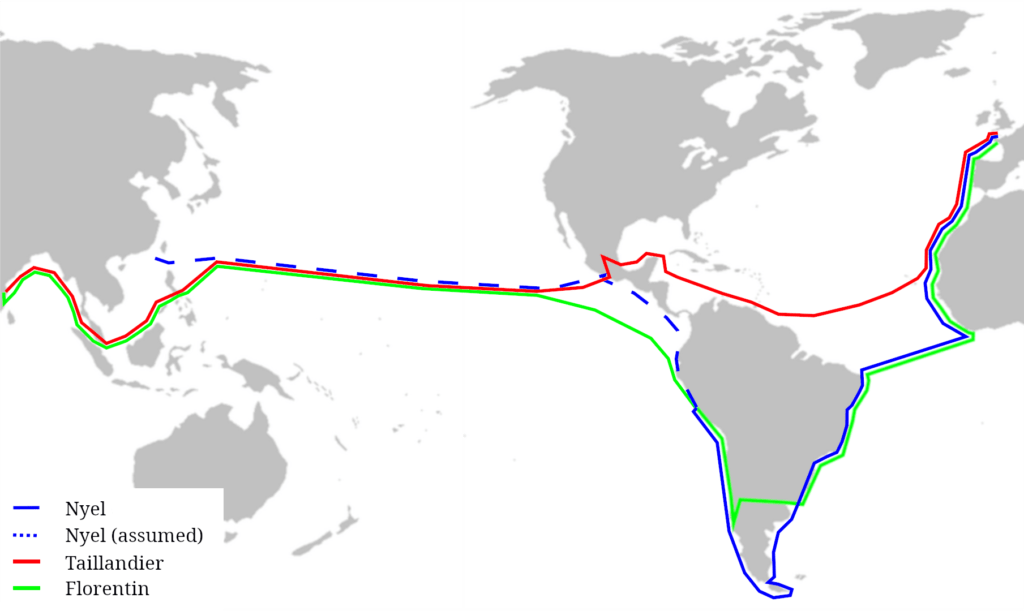
FIGURE 1. Estimated Routes of Nyel, Taillandier, and Florentin’s voyages, based on the locations mentioned in their letters. Nyel’s letter was sent from Lima, but claimed that he would soon find passage to Acapulco and continue on to China. By author.
Neither Taillandier’s nor Florentin’s letters explain why they did not sail around the Cape of Good Hope, which would have been a shorter journey to the Coromandel Coast. Only Nyel specified that, due to the ongoing War of the Spanish Succession, the British and the Dutch had blockaded vital straits in Southeast Asia. This meant he could not easily reach China by sailing east and therefore had to cross the Pacific. [7]Nyel, “Lettre du père Nyel”, 30. Furthermore, the Spanish crown allowed its allies to ship goods to the American colonies to put economic pressure on its enemies. The only condition was that they would respect the monopoly of Cadiz. However, Breton merchants quickly realized that the illicit trade was far more lucrative, and although France’s official stance was in favour of the Spanish Carrera, the administration often supported the traders’ efforts by granting them the cover of a passport for purposes of ‘exploration’. As a result, there is a noticeable spike in naval traffic between France and the Pacific during the war, as illustrated by Figures 2 and 3. The fact that Nyel’s expedition was originally intended for making discoveries but frequently halted in Chilean and Peruvian trade ports and made no further attempts to continue beyond them might signify that the captain also had ulterior, economic motives. Moreover, the area around Concepción became a playground for French smugglers, where they built several semi-permanent settlements with small shipyards, warehouses and dormitories. Perhaps this explains why Florentin first tried to find a new ship in Concepción. At the very least, it is no coincidence that these French Jesuits crossed the Pacific precisely when they did. [8]Lucien Bély, “Les négociations franco-espagnoles pendant la Guerre de Succession d’Espagne”, Cuadernos de Historia Moderna 1 (2013), 61-76, 64-65; Jean Martin, “Les toiles bretagnes dans le … Continue reading
The itineraries of the three Jesuits also indicate the uncertainty that characterized their transoceanic voyages. They suffered long delays, caused by volatile winds and storms which either blew a ship off its course or damaged it so that repairs were required before it could continue. Thus, they were subjected to captains’ decisions which did not always align with their personal interests. For example, when staying in the port of Arica for several months, Nyel complained about the long and tiresome wait, ardently wishing to reach China, but beginning to fear that the expedition would not make it there. [9]Nyel, “Lettre du père Nyel”, 50. In Lima, his concerns were proven right:
We had already been enjoying rest in Lima for some months, and we were preparing to set sail again for China, when our captains informed us that, finding themselves unable to undertake such a long voyage, they were obliged to return to France. This decision did not surprise us: they had their reasons; but it distressed us considerably, because we saw our sweetest hopes frustrated by it, at least for some time. [10]Ibid., 57-58: “Il y avoit déja quelques mois que nous goûtions le repos dans Lima, et que nous disposions à nous remettre en mer pour aller à la Chine, lorsque messieurs nos Capitaines nous … Continue reading
If a missionary’s ship decided to return to Europe earlier than anticipated, there was nothing the missionary could do other than go home with it or remain stranded in an unfamiliar place. However, Jesuits were not always left entirely to their own devices, as the global presence of the Society of Jesus served as a safety network, with its colleges and missions giving room and board to colleagues between voyages. [11]Brockey, “Largos Caminhos e Vastos Mares”, 48-49. This was the case for Florentin, who, upon his arrival in Santiago, went to stay at the local Jesuit college until he got word of a possible departure. In Lima he did the same. [12]Florentin, “Voyage aux Indes Orientales”, 283, 289-91. Nonetheless Jesuit travellers often had to make decisions on the spot in order to make it to their destinations. In other words, these missionaries were ‘maritime hitchhikers’, dependent on the availability of ships heading in the same direction and the goodwill of their crews to take them on.
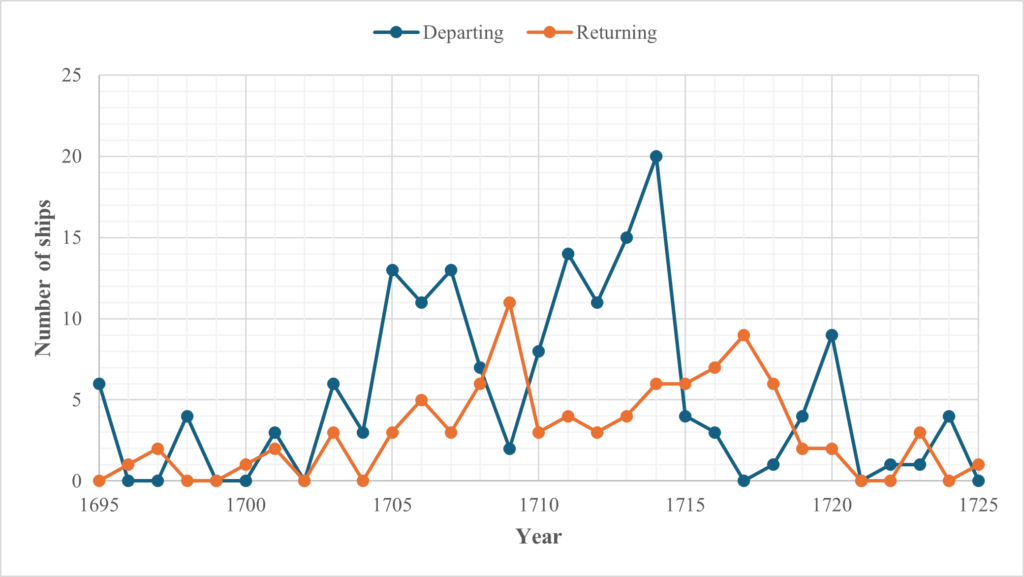
FIGURE 2. French ships departing to and returning from the Pacific. From E.W. Dahlgren, Voyages français à destination de la Mer du Sud avant Bougainville (1695–1749) (Paris: Imprimerie Nationale, 1907), 446.
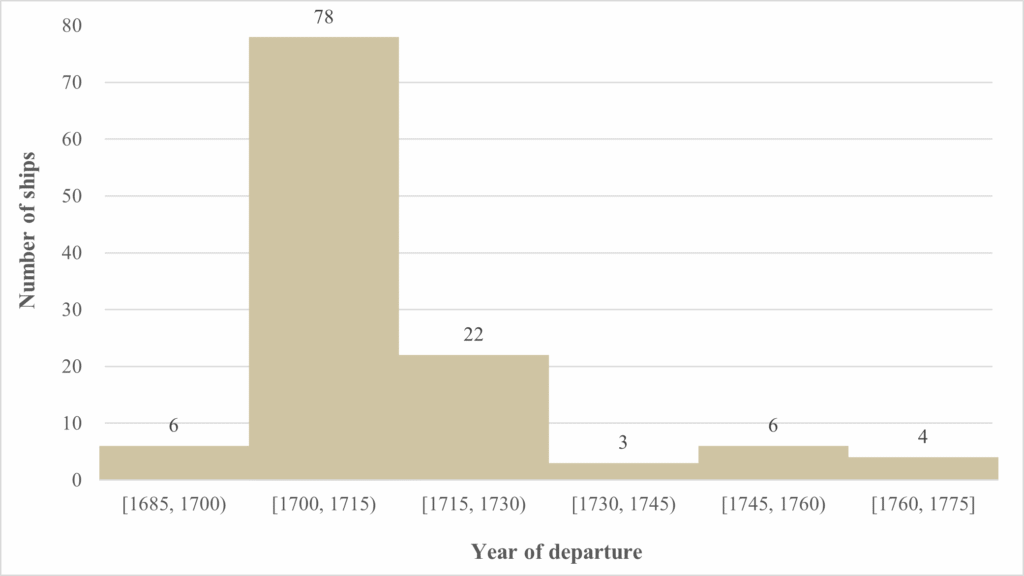
FIGURE 3. Ships departing from Saint Malo with destinations Chili, Chine, Mers du Sud, Mexique, and/or Pérou. Data from Roger Martin Desgreves and Julien Thomas-Cadiou, Navires de Saint-Malo des XVIIe et XVIIIe siècles (Rennes: Association Parchemin, 1992).
Consequently, they were repeatedly confronted with new environments. For instance, Taillandier noted the unfamiliar characteristics of the Spanish galleon in Acapulco: “The ship’s crew consisted of 260 men from all the different nations of the world. The majority of the sailors were from the Philippines. The duke of Albuquerque, viceroy of Mexico, appointed Father Bonnet as ship’s almoner. We used the Spanish language to hear confessions and instruct the entire crew”. [13]Taillandier, “Lettre du père Taillandier”, 130: “Le Vaisseau estoit de 260 hommes d’équipage de toutes les differentes Nations du monde. Le plus grand nombre des Matelots estoit des … Continue reading Suddenly, he had to speak a different language to an unfamiliar crew, and he found that the viceroy of New Spain could directly interfere in a ship’s activity. Some time later, Taillandier expressly objected to having to travel on board of a ship manned by Muslims: “We would have needed no more than a month to reach Pondicherry if we had arrived a couple of days earlier, before the Portuguese or Armenian ships left for the Coromandel Coast. But we were obliged to board a Moorish ship, which was a hardship and a disgrace for us”. [14]Taillandier, “Lettre du père Taillandier”, 149: “Il ne nous falloit plus qu’un mois pour nous rendre à Ponticherry; si nous fussions arrivez quelques jours plustost, avant que les vaisseaux … Continue reading Conversely, Florentin found himself on a Protestant Danish vessel, whose captain granted him passage “with great politeness”, despite their religious differences. [15]Florentin, “Voyage aux Indes Orientales”, 298: “je demandai passage au Capitaine Danois, qui me l’accorda avec beaucoup de politesse”.
The situation of these French Jesuits seems much more disordered than that of their Portuguese colleagues travelling east on the Carreira da Índia. Of course, Society members at sea faced many of the same challenges, including the constant risk of disease and disaster. When examining the organizational structures, however, it is clear that they were more clearly defined in the Portuguese cases. At Lisbon, the Society thoroughly planned the voyages of outbound Jesuits by dividing missionaries into manageable groups, scheduling departures and packing rations. Once the fleet had set sail, they pursued a rigid hierarchy on board to emulate the college environment they were familiar with. This involved the enforcement of daily confessional routines, rules to maintain physiological and psychological well-being and regulations for the division of non-spiritual labour on board. These extensive measures were meant to prevent or mitigate interpersonal conflicts, which were all too common with so many people confined in a small space, during a long and arduous voyage. [16]Brockey, “Largos Caminhos e Vastos Mares”, 46-53, 60.
Neither Nyel, Taillandier, nor Florentin mentioned such a clearcut system. Only Taillandier, referring to another missionary being appointed to the position of ship’s almoner, might have indicated a supervisory position. [17]Taillandier, “Lettre du père Taillandier”, 130. Yet, as this was done by the viceroy of New Spain, it only applies to the Spanish and not the French network. It is possible that the three Jesuits simply did not mention these organizational elements, since the recipients of the letters already knew what they entailed. It could also mean that the Parisian editors chose not to include fragments from the original manuscripts that do mention an on-board hierarchy, believing it was of no interest to the reading public. Nonetheless the lack of clear regulations and supervisory measures explains the more ad hoc nature of the Jesuits’ voyages. In fact, from the middle of the seventeenth century onwards, Portuguese missionaries started dealing with similar issues as those of their French opposite numbers. The growing influence of other European powers in South and Southeast Asia, combined with a shift in interest towards Brazil, made the Portuguese connections with India and China increasingly infrequent. Jesuits travelling on the Carreira da Índia therefore started making occasional use of Dutch and English ships to make it to their destination, thus also becoming ‘maritime hitchhikers’. [18]Brockey, “Largos Caminhos e Vastos Mares”, 67.
In short, the War of the Spanish Succession marked a period with a significant increase in French navigation in the Pacific. However, the state failed to maintain its own trading company in the East Indies and—considering the amount of illicit activity in the Chilean and Peruvian markets— struggled to regulate private ventures. French Jesuits hence lacked a state-sponsored framework to facilitate their travels and instead had to make do with voyages organized by independent shipowners more inclined to act in their own self-interest. [19]Bély, “Les négociations franco-espagnoles”, 65; Gottmann, “French-Asian Connections”, 539. When subsequently the voyage did not go according to plan, the missionaries had to improvise a new route to their destination. This meant that their voyages were often much lengthier than expected: Nyel took over six years to reach China, while Taillandier and Florentin were both in transit for about three years.
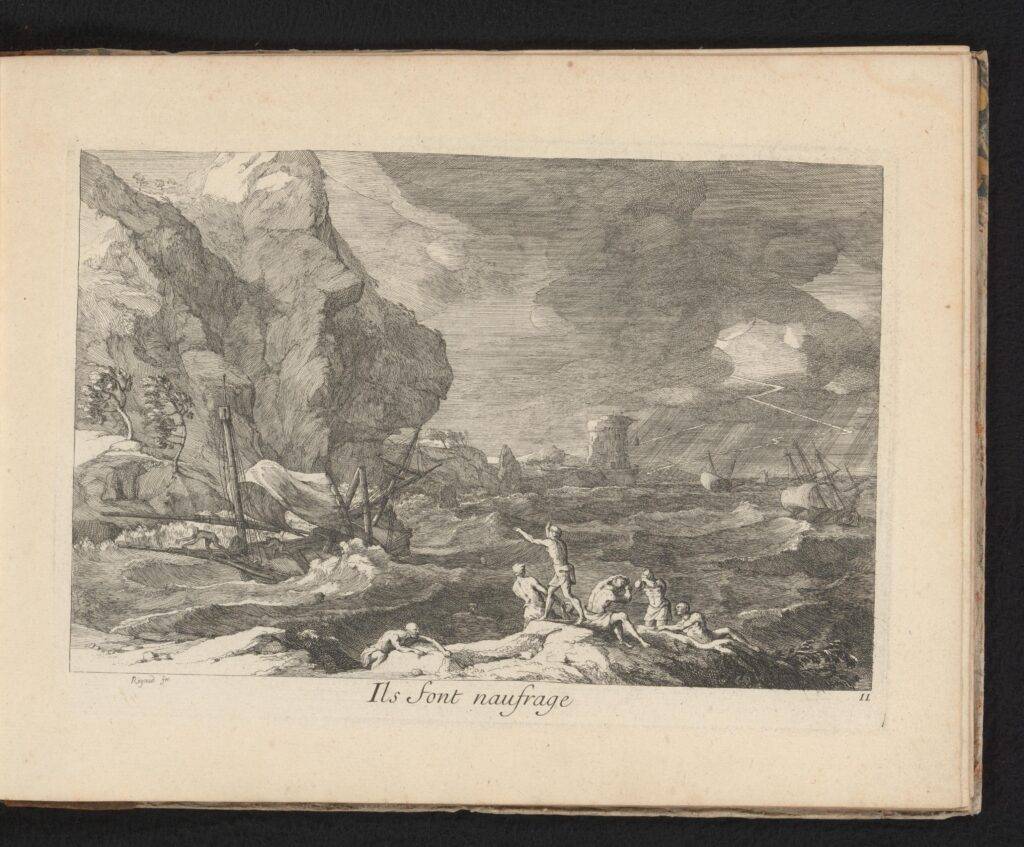
FIGURE 4. Shipwrecked sailors climb onto a rock during a storm. Jacques Rigaud, Ils font naufrage, ca. 1700–ca. 1725, print, 190 x 273 mm (Amsterdam, Rijksmuseum, RP-P 2008-511-12, https://id.rijksmuseum.nl/200763131).
References
| ↑1 | E. W. Dahlgren, Voyages français à destination de la Mer du Sud avant Bougainville (1695–1749) (Paris: Imprimerie Nationale, 1907), 455-56. |
|---|---|
| ↑2 | Nyel, “Lettre du père Nyel”, 30-33, 45-46, 57-58. |
| ↑3 | Dehergne, Répertoire Des Jésuites de Chine, 188-89. |
| ↑4 | Delphine Tempère, “L’épreuve du voyage en mer pour les missionnaires jésuites: souffrances et émotions de passagez”, Annales de Bretagne et des Pays de l’Ouest 121:3 (2014), 177-197, 188. |
| ↑5 | Taillandier, “Lettre du père Taillandier, missionnaire de la Compagnie de Jésus, au père Willard de la mesme compagnie”, in Lettres édifiantes et curieuses, ed. Jean-Baptiste Du Halde, vol. 9, 34 vols. (Paris: Nicolas le Clerc, 1715), 92-172. |
| ↑6 | Florentin, “Voyage aux Indes Orientales par le Paraguay, le Chili, le Perou, etc”., in Lettres édifiantes et curieuses, ed. Jean-Baptiste Du Halde, vol. 13, 34 vols. (Paris : Nicolas le Clerc, 1718), 228-99. |
| ↑7 | Nyel, “Lettre du père Nyel”, 30. |
| ↑8 | Lucien Bély, “Les négociations franco-espagnoles pendant la Guerre de Succession d’Espagne”, Cuadernos de Historia Moderna 1 (2013), 61-76, 64-65; Jean Martin, “Les toiles bretagnes dans le commerce francoespagnol de 1550 à 1830”, Annales de Bretagne et des Pays de l’Ouest 119:1 (2012), 31-60, 47. |
| ↑9 | Nyel, “Lettre du père Nyel”, 50. |
| ↑10 | Ibid., 57-58: “Il y avoit déja quelques mois que nous goûtions le repos dans Lima, et que nous disposions à nous remettre en mer pour aller à la Chine, lorsque messieurs nos Capitaines nous déclarerent, que se trouvant hors d’état d’entreprendre un si long voyage, ils étoient obligez de s’en retourner en France. Cette resolution nous surprit point: ils avoient leurs raison; mais elle nous affligea sensiblement: parce que nous voyïons par là frustrez, au moins pour un temps, de nos plus douces esperances”. |
| ↑11 | Brockey, “Largos Caminhos e Vastos Mares”, 48-49. |
| ↑12 | Florentin, “Voyage aux Indes Orientales”, 283, 289-91. |
| ↑13 | Taillandier, “Lettre du père Taillandier”, 130: “Le Vaisseau estoit de 260 hommes d’équipage de toutes les differentes Nations du monde. Le plus grand nombre des Matelots estoit des Philippines. Le Duc d’Albuquerque Viceroy du Mexique, avoit nommé le Père Bonnet pour Aumosnier du Vaisseau. La langue Espagnole nous servit à entendre les confessions, et à instruire tout l’équipage”. |
| ↑14 | Taillandier, “Lettre du père Taillandier”, 149: “Il ne nous falloit plus qu’un mois pour nous rendre à Ponticherry; si nous fussions arrivez quelques jours plustost, avant que les vaisseaux Portugais ou Arméniens partissent pour la coste de Coromandel : mais nous fusmes obligez de nous mettre sur un navire More, ce qui fut pour nous une source de travaux et de disgrace”. |
| ↑15 | Florentin, “Voyage aux Indes Orientales”, 298: “je demandai passage au Capitaine Danois, qui me l’accorda avec beaucoup de politesse”. |
| ↑16 | Brockey, “Largos Caminhos e Vastos Mares”, 46-53, 60. |
| ↑17 | Taillandier, “Lettre du père Taillandier”, 130. |
| ↑18 | Brockey, “Largos Caminhos e Vastos Mares”, 67. |
| ↑19 | Bély, “Les négociations franco-espagnoles”, 65; Gottmann, “French-Asian Connections”, 539. |
The longer missionaries were travelling, the longer they were exposed to cramped and unhygienic conditions on board, extreme temperatures and mountainous seas. At the time, the many dangers at sea were unmistakably present in the collective consciousness of European society. In the larger genre of early modern travel literature, the eyewitness accounts of shipwrecked sailors formed their own best-selling niche. [1]Margarette Lincoln, “Shipwreck Narratives of the Eighteenth and Early Nineteenth Century: Indicators of Culture and Identity”, Journal for Eighteenth-Century Studies 20:2 (1997), 155-172, 155-59. The subject was also quite popular in visual media, as demonstrated by the print shown in Figure 4. The elements depicted in the image above, such as thunderstorms, ships running into steep cliffs and crews left stranded on the coast, are themes that also emerge in the letters of Nyel, Taillandier and Florentin.
The three Jesuit voyagers all wrote about the risks they encountered during their travels. The bulk of these descriptions cover environmental phenomena, which is not surprising given the impact of meteorological and hydrological processes on water transport. The wind affects the roughness of the waves and the motion of sailing vessels, fog and precipitation limit horizontal visibility, and an overcast sky restricting observation of the stars was a detriment to navigation. Furthermore, the northern tropical Pacific Ocean is a hotbed of tropical cyclones, especially in late summer and early autumn. Sea travel is thus heavily dependent on atmospheric phenomena but equally sensitive to them. [2]Sergey M. Govorushko, Natural Processes and Human Impacts (Dordrecht: Springer, 2012), 87-89, 91, 126, 158-59.
The first risk posed by nature which the voyagers made note of was seasonal change. Nyel remarked that he had not seen any of Tierra del Fuego’s Indigenous population and concluded that they had already migrated north to wait out the colder months. [3]Nyel, “Lettre du père Nyel”, 35. Later, he experienced first hand why these seasonal migrations took place: “we began to endure the harshness of this climate during the winter, due to the great cold, the hail, the never ending rain and the brevity of the days, which lasted no more than eight hours and were always very dark, leaving us in a sort of continuous night”. [4]Ibid., 45: “nous commençasmes à éprouver la rigueur de ce clîmat durant l’hyver, par le grand froid, la gresle, les pluyes, qui ne cessoient point, et par la brieveté des jours, qui ne … Continue reading Nyel invoked an image of a sorrowful and inhospitable environment, making the winter a drawn-out, inescapable hardship which had to be endured, and seeming to turn the season into a long test of perseverance. Nyel characterized these changes in the weather patterns as a source of danger. When setting out to double Cape Horn, immediately following his description of the winter climate, he wrote: “Thus we entered that stormy sea, where we suffered great gusts of wind that separated our ship from the one commanded by monsieur Fouquet, and where we weathered violent storms which had us believe more than once that we would be stranded in some strange land”. [5]Ibid, 45-46: “Nous entrasmes donc dans cette mer orageuse, où nous souffrismes de grands coups de vent, qui sépararent notre Vaisseau de celui que commandoit Monsieur Fouquet, et où nous … Continue reading Taillandier made similar observations about the risks posed by the cold season, but his account took a more direct approach in depicting the dangers:
Because this final navigation was made during winter, we had to weather heavy storms without being able to stop along the way. The ship that brought us to the Philippines was at sea for seven months during this crossing. The admiral was obliged to anchor at the entrance to the Philippines, after a heavy swell submerged the entire ship. Some of the provisions were ruined, and seven men were dragged into the sea. Two of them were pulled back on to the ship by another swell. [6]Taillandier, “Lettre du père Taillandier”, 131-132: “Comme c’est dans l’hiver que se fait cette dernière navigation, on a de rudes tempestes à esluyer, sans pouvoir relascher dans la … Continue reading
Thus, while Nyel’s narration remained relatively distant, Taillandier vividly revealed the deadly force of the ocean to his readers. Witnessing five sailors drown seems to have impacted him quite a bit because he stressed that the crew remained careful and alert to prevent further casualties: “We had some rather violent squalls, but apart from one time when we let ourselves be surprised, we always remained on our guard to lower the sails in time”. [7]Ibid., 134: “Nous eusmes quelques grains assez violens, mais excepté une fois qu’on se laissa surprendre, on se tint toujours sur ses gardes, pour amener les voiler à propos”.
Upon entering the Philippine Archipelago, Taillandier was confronted with a very different issue. Although he endured several storms while crossing the Pacific, a lack of wind now made it difficult to sail because his ship was subject to sea currents and opposing tides. The crew tried to mitigate this by attaching a sloop to the front and directing the vessel manually, but despite these efforts they drifted between several small islands, and things quickly took a turn for the worse. [8]Ibid., 135-36. Eventually they lost control of the ship, and it crashed into the cliffs: “[The front of the ship] struck a steep rock off one of these isles. Fortunately, there was enough depth to avoid running aground, and the current, having made us pirouette, threw us in the middle of this sort of harbour, where we anchored to await the wind which finally pulled us out of this predicament”. [9]Ibid., 136: “Nostre vergue de civadiere toucha un rocher fort escarpé d’une de ces isles : par bonheur il y avoit assez de fond pour ne as échoüer, et le courant nous ayant fait piroüetter, … Continue reading Just like Nyel’s difficulties sailing around Tierra del Fuego, the final stretch of the transpacific voyage proved to be equally challenging to Taillandier. He pointedly observed that “The strait between the Philippine Isles up until Manila is about a hundred leagues long. Navigation is difficult there, either because of the rapid currents or because there are very few places where one can anchor”. [10]Ibid., 134 35: “Le détroit entre les Isles Philippines jusqu’à Manile, a environ 100 lieues de longueur. La navigation y est difficile, soit à cause des courans rapides, soit parcequ’il y a … Continue reading Florentin very similarly remarked that “The shallows, the rocks and the very rapid currents make the passage through this strait very difficult and very dangerous”. [11]Florentin, “Voyage aux Indes Orientales”, 295: “Les basses, les rochers, et les courans qui sont très-rapides, rendent le passage de ce canal très-difficile, et très dangereux”.
Florentin neither elaborated on these hazards nor depicted a life or death situation resulting from meteorological dangers, but he did allocate several paragraphs to the spread and impact of disease. While resting in the Philippines, the Jesuit caught an infection, which he dramatized heavily in his account: “A violent sickness which struck me in Manila reduced me to the brink of death. We had completely lost hope of my recovery when I turned to the great apostle of the Indies, Saint Francis Xavier. No sooner was my prayer finished than I felt much better, and two days later I was able to celebrate the holy sacrifice of the mass”. [12]Ibid., 297: “Une maladie violente dont je suis attaqué à Manille, me réduisit à l’extremité. On désesperoit absolument de ma guérison, lorsque j’eus recours au grand Apotre des Indes, … Continue reading Perhaps, like many others missionaries, Florentin was unaccustomed to the heat and humidity of the tropical climate and fell ill because of it. [13]Tempère, “L’épreuve du voyage en mer pour les missionnaires jésuites”, 189. He underwent a seemingly miraculous recovery, but it was not the last time he would be confronted with disease because when travelling on the Danish ship another deadly affliction took hold. This time Florentin managed to avoid infection, although others were not so fortunate: “The sickness spread amongst the crew. We lost the captain, who died in my arms with great feelings of piety”. [14]Florentin, “Voyage aux Indes Orientales”, 297: “La maladie se mit dans l’équipage: nous perdîmes le Capitaine qui mourut entre mes bras, avec de grands sentimens de piété”.
Illnesses were commonplace on board galleons crossing the Pacific Ocean, so it is no surprise that Florentin encountered them on his voyage. Poor hygiene, an inadequate diet and the widespread presence of smallpox in port towns were all major risk factors that were reinforced by the length of the route from the Americas to East and Southeast Asia. Usually, sick members of the crew were confined to an infirmary on the ship until they could be disembarked at the next port. [15]Angela Schottenhammer, “Some Insights into the Medical Situation on Board of Galleons Traveling across the Pacific Ocean in the Eighteenth Century”, Asian Review of World Histories 12 (2024), … Continue reading Moreover, as tending to the sick was one of the tasks required of travelling missionaries, they were even more at risk due to regular contact with passengers potentially carrying an infectious disease. [16]Brockey, “Largos Caminhos e Vastos Mares”, 57-58. However, Florentin’s discussion of illness steers clear from speculating about causes or describing treatments, instead allowing religion to take centre stage. While the Protestant captain passed away, Florentin managed to survive his own ailment by appealing to a Catholic saint.
Calling upon saints is a rhetorical strategy that was often employed by missionaries narrating maritime disasters. Sailors mostly addressed the Virgin Mary or Saint Elmo, their patron saint, to calm the seas, but the Jesuits were not convinced that the popular commitment to these figures was very effective. Instead, wanting to prove the exceptionalism of their Society’s venerated co founders, they pleaded for protection from Ignatius of Loyola and Francis Xavier. In fact, Jesuit missionaries did this even before either Ignatius or Francis Xavier were officially canonized by the Church as a strategy to promote devotion to them. Florentin’s prayers for good health to the latter saint can thus be seen as part of an established tradition. Another measure that missionaries took in an attempt to prevent being shipwrecked during storms was to cast relics into the ocean. Again this relates to an older custom practised by sailors, who would throw talismans into the sea. [17]Delphine Tempère, “Marins et missionnaires face aux dangers des navigations océaniques au XVIIe siècle: Catastrophes, recours matériels et médiations spirituelles”, e-Spania 12 (2011), 1-26, … Continue reading By adapting existing practices to their own agenda, Jesuits could centre themselves as heroic figures able to act as mediators between the natural and the supernatural worlds. Only by their efforts were miracles made possible, and their presence on board supposedly assured the sailors that they would remain safe. In other words, Jesuit missionaries could exaggerate their importance by dramatizing the dangers they encountered at sea, which contributed to the propaganda in their correspondence. [18]Tempère, “L’épreuve du voyage en mer pour les missionnaires jésuites”, 187-91.
However, it seems that the accounts of the three French Jesuits do not show evidence of these general characteristics. Although Nyel and Taillandier found themselves in dire circumstances multiple times, not once did they write about praying to a specific saint, making use of relics, or taking any other form of direct action to prevent disaster. They did not present themselves as active mitigators, but rather as passive bystanders to supernatural powers made evident through meteorological phenomena. In some cases, calamities were seen as part of a greater plan, in the same way that a deluge can be perceived as God’s way to bring order out of chaos. [19]Tempère, “Marins et missionnaires face aux dangers des navigations océaniques au XVIIe siècle”, 1-2. For example, Nyel believed disastrous events could turn out to be advantageous in the long term, arguing that “many flourishing missions owed their origin to a shipwreck or some other occurrence that seemed to come from nothing but chance”. [20]Nyel, “Lettre du père Nyel”, 37-38: “bien de florissantes missions devoient leur origine à un naufrage, ou à quelqu’autre rencontre qui paroissoit ne venir que du hazard”. His emphasis on coincidence also promotes the idea that missionaries had no control over their fate when faced with the forces of nature. Whether they lived or died was entirely contingent on the will of an all-powerful God:
We, whom God has kept healthy thus far, even though we know all the difficulties of the tiring journey we still have to make, will undertake it full of courage and hope that heaven will protect us and bring us conveniently to the destination for which we long. This is the favour we pray all our Fathers to ask for us, so that we may sacrifice our lives in the glorious work of preaching the gospel and converting the infidels. [21]Ibid., 59: “Pour nous, à qui Dieu a conservé jusqu’ici la santé, quoy que nous connoissions toutes les difficultez du fatiguant trajet qui nous reste à faire, nous l’entreprenons tout … Continue reading
In this way, the transoceanic voyage became a sort of trial by ordeal—or, as Taillandier put it: “God sometimes tests his missionaries before employing them in his service”. [22]Taillandier, “Lettre du père Taillandier”, 149: “Dieu éprouve quelquefois les missionnaires, avant que de les employer à son service”. Hardships at sea were interpreted as a prelude to the adversity and suffering they might face at the mission. Surviving the voyage demonstrated their faithfulness and determination, proving that they were prepared to martyr themselves for the greater good of all Christianity. [23]Tempère, “L’épreuve du voyage en mer pour les missionnaires jésuites”, 192-94.
References
| ↑1 | Margarette Lincoln, “Shipwreck Narratives of the Eighteenth and Early Nineteenth Century: Indicators of Culture and Identity”, Journal for Eighteenth-Century Studies 20:2 (1997), 155-172, 155-59. |
|---|---|
| ↑2 | Sergey M. Govorushko, Natural Processes and Human Impacts (Dordrecht: Springer, 2012), 87-89, 91, 126, 158-59. |
| ↑3 | Nyel, “Lettre du père Nyel”, 35. |
| ↑4 | Ibid., 45: “nous commençasmes à éprouver la rigueur de ce clîmat durant l’hyver, par le grand froid, la gresle, les pluyes, qui ne cessoient point, et par la brieveté des jours, qui ne duroit que huit heures, et étant toûjours très-sombres, nous laissoient dans une espece de nuit continuelle”. |
| ↑5 | Ibid, 45-46: “Nous entrasmes donc dans cette mer orageuse, où nous souffrismes de grands coups de vent, qui sépararent notre Vaisseau de celui que commandoit Monsieur Fouquet, et où nous essuyasmes des tempêtes violentes qui nous firent craindre, plus d’une fois, de tomber sur quelque terre inconnuë”. |
| ↑6 | Taillandier, “Lettre du père Taillandier”, 131-132: “Comme c’est dans l’hiver que se fait cette dernière navigation, on a de rudes tempestes à esluyer, sans pouvoir relascher dans la route. Le navire qui nous porta aux Philippines, avoit demeuré sept mois dans cette traversée. L’Amiral fut obligé de relascher à l’entrée des Philippines, après avoir reçu un coup de mer qui mit tout le Navire sous l’eau. Une partie de ses vivres fut gastée, et sept hommes furent emportez dans la mer. Il y en eut deux qui furent rejettez dans le vaisseau par un autre coup de mer”. |
| ↑7 | Ibid., 134: “Nous eusmes quelques grains assez violens, mais excepté une fois qu’on se laissa surprendre, on se tint toujours sur ses gardes, pour amener les voiler à propos”. |
| ↑8 | Ibid., 135-36. |
| ↑9 | Ibid., 136: “Nostre vergue de civadiere toucha un rocher fort escarpé d’une de ces isles : par bonheur il y avoit assez de fond pour ne as échoüer, et le courant nous ayant fait piroüetter, nous jetta au milieu de cette espece de port, où nous moûillasmes pour attendre le vent qui nous tira enfin d’un si mauvais pas”. |
| ↑10 | Ibid., 134 35: “Le détroit entre les Isles Philippines jusqu’à Manile, a environ 100 lieues de longueur. La navigation y est difficile, soit à cause des courans rapides, soit parcequ’il y a très peu d’endroits où l’on puisse moüiller”. |
| ↑11 | Florentin, “Voyage aux Indes Orientales”, 295: “Les basses, les rochers, et les courans qui sont très-rapides, rendent le passage de ce canal très-difficile, et très dangereux”. |
| ↑12 | Ibid., 297: “Une maladie violente dont je suis attaqué à Manille, me réduisit à l’extremité. On désesperoit absolument de ma guérison, lorsque j’eus recours au grand Apotre des Indes, saint François Xavier. Ma prière ne fut pas plustost achevee, que je me sentis beaucoup mieux, & deux jours après, je fus en estat de célébrer le saint Sacrifice de la Messe”. |
| ↑13 | Tempère, “L’épreuve du voyage en mer pour les missionnaires jésuites”, 189. |
| ↑14 | Florentin, “Voyage aux Indes Orientales”, 297: “La maladie se mit dans l’équipage: nous perdîmes le Capitaine qui mourut entre mes bras, avec de grands sentimens de piété”. |
| ↑15 | Angela Schottenhammer, “Some Insights into the Medical Situation on Board of Galleons Traveling across the Pacific Ocean in the Eighteenth Century”, Asian Review of World Histories 12 (2024), 319-348, 330-35. |
| ↑16 | Brockey, “Largos Caminhos e Vastos Mares”, 57-58. |
| ↑17 | Delphine Tempère, “Marins et missionnaires face aux dangers des navigations océaniques au XVIIe siècle: Catastrophes, recours matériels et médiations spirituelles”, e-Spania 12 (2011), 1-26, 6-9. |
| ↑18 | Tempère, “L’épreuve du voyage en mer pour les missionnaires jésuites”, 187-91. |
| ↑19 | Tempère, “Marins et missionnaires face aux dangers des navigations océaniques au XVIIe siècle”, 1-2. |
| ↑20 | Nyel, “Lettre du père Nyel”, 37-38: “bien de florissantes missions devoient leur origine à un naufrage, ou à quelqu’autre rencontre qui paroissoit ne venir que du hazard”. |
| ↑21 | Ibid., 59: “Pour nous, à qui Dieu a conservé jusqu’ici la santé, quoy que nous connoissions toutes les difficultez du fatiguant trajet qui nous reste à faire, nous l’entreprenons tout pleins de courage et d’esperance que le Ciel nous protegera, et nous conduira heureusement au terme, aprés lequel nous soupirons. C’est la grâce que nous prions tous nos Peres de demander pour nous, afin que nous puissions sacrifier nos vies dans le ministere glorieux de la Predication de l’Evangile, et de la conversion des Infidelles”. |
| ↑22 | Taillandier, “Lettre du père Taillandier”, 149: “Dieu éprouve quelquefois les missionnaires, avant que de les employer à son service”. |
| ↑23 | Tempère, “L’épreuve du voyage en mer pour les missionnaires jésuites”, 192-94. |
In contrast to these depictions of danger, the Jesuits did not always associate the natural environment with distress. Nyel remarked that, after his troubles at Cape Horn, he entered calmer seas, and the journey became less challenging. [1]Nyel, “Lettre du père Nyel”, 47. Florentin also briefly recounted his crossing of the Pacific as taking three months of smooth sailing, during which the trade winds carried him comfortably to the Mariana Islands. [2]Florentin, “Voyage aux Indes Orientales”, 291-92: “Nous eusmes trois mois d’une navigation très-douce ; les vents alizez qui regnent sur cette Mer, nous porterent très commodément aux … Continue reading Thus, it appears that the missionaries’ perceptions of the natural world were multilayered. While the environment could be hostile at one point, it could be quite agreeable at another, and this volatility seems to have piqued the Jesuits’ interest. The letters of Nyel, Taillandier and Florentin contain many reflections about weather phenomena and the calculation of space. In other words, they were questioning how and why particular natural events occurred in specific places.
Their tendency to observe and communicate environmental conditions can be explained by the fact that natural philosophy and natural history were part of the curriculum in Jesuit colleges. Their knowledge of Aristotle’s and Pliny’s works formed a frame of reference for describing animals, plants, minerals and natural processes in both the Old World and the New. Every Jesuit thus had some academic understanding of the forces of nature, and quite rapidly the figure of the ‘Jesuit scientist’ emerged. Already in the early decades of the Society, writers such as Acosta, Acuña and Cobo published extensive studies of the natural history of overseas regions, and many others soon followed. The authors of the Edifying and Curious Letters were no exception. [3]José Ignacio García, “The Contributions of European Jesuits to Environmental Sciences”, Journal of Jesuit Studies (Leiden) 3:4 (2016), 564; Agustín Udías, Jesuit Contribution to Science: A … Continue reading
A subject that repeatedly occurred in the letters of the three French Jesuits is the behaviour of the wind. Taillandier in particular wrote substantially about this phenomenon. First, he warned his readers about the dangerous return route from the Philippines to New Spain compared to the outward crossing: “This voyage is very smooth: there is no need to fear contrary winds, and the wind that blows, being always fresh, softens the heat. But as much as the voyage from Acapulco to Manila is easy, the return from Manila to Acapulco is terrible and dangerous”. [4]Taillandier, “Lettre du père Taillandier”, 130-31: “Cette navigation est très douce : on n’a point à craindre de vents contraires ; et le vent qui souffle estant toujours frais, tempere la … Continue reading The way back was indeed much more challenging, and it often took twice as long—if not longer—to reach the Pacific Coast of New Spain. The voyage entailed a difficult exit from the Philippine straits and a crossing of the cyclone-ridden North Pacific, eventually to sail south along the windy Californian coast towards Acapulco. [5]Cameron La Follette and Douglas Deur, “Views Across the Pacific: The Galleon Trade and Its Traces in Oregon”, Oregon Historical Quarterly 119:2 (2018), 160-191, 169. At the time of writing, Taillandier’s observation was not new information, as mapmakers in Europe were already depicting the general direction of the Pacific trade winds. For example, Figure 5 shows a map portraying the Pacific as having ‘variable winds’ beyond the tropics, suggesting that the region’s weather was unpredictable and dangerous.
It is important to note that Taillandier’s characterization of the return voyage was not a first-hand observation. Hence, unlike his descriptions of his own exposure to hazardous weather—although just as dramatic—this observation was most unlikely to have been intended to provoke thoughts of near-martyrdom. On the contrary, by stressing the high risks of the voyage back to Acapulco, he made his own travels seem rather pleasant in comparison. This contradiction therefore suggests a second intention in Taillandier’s letter. It seems that by supplementing his own experiences with knowledge that was already in circulation, he was attempting to sketch a comprehensive understanding of meteorological processes in the Pacific. With this observation in mind, the reader thus catches a glimpse of Taillandier’s self-portrayal as a scientist striving for complete knowledge. This idea becomes even clearer in the following example, in which the Jesuit expands upon the wet season in the Philippines:
For eighteen days there was continuous rain, which only ceased intermittently and for short periods. These rains recurred several times until November, and sometimes until December. Hence, all the plains were flooded: one travels by canoe through the rice fields, which from afar seem like lovely meadows. It is this abundant rain that moderates the heat, and—being caused by the west wind— makes the climate of Manila very humid. [6]Taillandier, “Lettre du père Taillandier”, 137: “Il y eut pendant 18 jours une pluye continuelle, qui ne cessoit que par intervalle, et pour peu de temps. Ces pluyes recommencent ainsi à … Continue reading
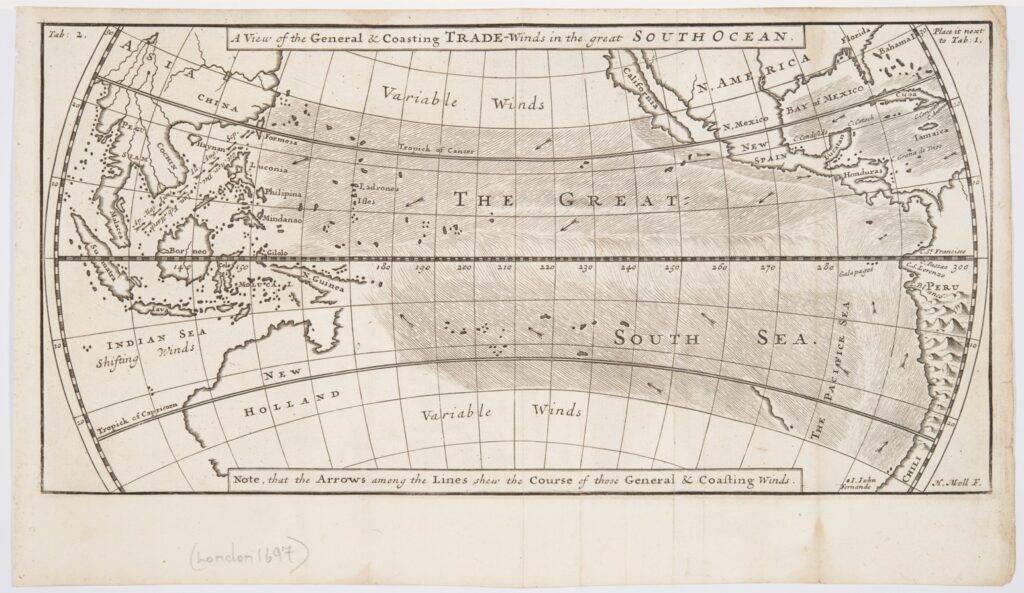
FIGURE 5. A map depicting air currents in the Pacific Ocean. Herman Moll, A view of the general and coasting trade-winds in the great South Ocean (London, 1697?, Sydney, State Library of New South Wales, M2 110/1697/1, https://collection.sl.nsw.gov.au/record/74VvND6QdzXM).
Taillandier’s description fits the characteristics of the monsoon. This phenomenon is often defined as either seasonal rainfall or a circulating reversal of the wind direction. However, monsoons have some other associated features, such as cloudiness, changes in air temperature and floods. In the Philippines, the southwest winds prevail from May to October, mainly affecting the western half of the Archipelago where Manila is located. As the monsoon air blows over the warmer areas of the ocean around the equator, it carries plenty of water vapour and causes the heavy rainfall described by Taillandier. [7]Yves Boquet, The Philippine Archipelago (Cham: Springer, 2017), 43-48; Kshudiram Saha, Tropical Circulation Systems and Monsoons (Berlin: Springer, 2010), 24-25. Interestingly, the Jesuit refrained from using “monsoon” to denote the wet season, although the word does show up later in his letter to signify the changing winds: “In the seas of the East Indies, from Cochinchina, China and the Philippines to the Mariana Islands, [the winds] change regularly according to the different seasons of the year: this is what is called the monsoon”. [8]Taillandier, “Lettre du père Taillandier”, 175-76: “Dans les mers des Indes Orientales de la Cochinchine, de la Chine, des Philippines jusqu’aux Isles Marianes, ils changent régulierement … Continue reading The same can be said for Florentin, who also associated the monsoon exclusively with the wind. When narrating his difficulties in sailing through the Philippines, he wrote that “The monsoon had changed, the winds coming from the southwest were contrary to us, and it took us more than a month and a half to travel 80 leagues in this strait”. [9]Florentin, “Voyage aux Indes Orientales”, 295: “La mousson avoit change, les vents qui estoient au Sud-Oüest nous estoient contraires, et nous fusmes plus d’un mois et demi à faire 80 … Continue reading Upon entering the Indian Ocean, he reminisced about how smoothly he had travelled before the prevailing wind direction changed: “The season, which was already advanced, kept us for almost three months on a crossing that one makes in less than three weeks during the monsoon season”. [10]Ibid., 298: “La saison qui estoit déjà avancée, nous retint près de trois mois dans une traversée qu’on fait au temps de la mousson en moins de trois semaines”.
Another recurring subject in the Edifying and Curious Letters which demonstrates the Jesuits’ scientific tendencies is their attention to landscapes, coordinates and maps. Again, this is not surprising, as the Society of Jesus taught geography—or more accurately, cosmography—to its students. This entailed both the mathematical and the descriptive traditions that were rooted in the works of the Greek philosophers. Jesuits thus had experience of defining space through projections using spherical geometry on the one hand and of interpreting space through perceptions and experiences on the other. The French colleges were especially innovative, given that Philippe Briet, Georges Fournier and Jean François all published ground-breaking geographical studies in the middle of the seventeenth century. [11]Mirela Altic, Encounters in the New World: Jesuit Cartography of the Americas (Chicago: University of Chicago Press, 2022), 12-15. In this respect it makes sense that Nyel, Taillandier and Florentin should have continued this trend more than half a century later.
Florentin was the least occupied with geography, opting exclusively for a descriptive approach and offering limited information. His descriptions of the settlements he visited follow a pattern of first calculating the location approximately and then briefly outlining the local scenery. When depicting Santiago, the Chilean capital, he mentioned that it “is situated at about the same latitude as Mendoza”, but without giving any exact measurements. [12]Florentin, “Voyage aux Indes Orientales”, 278: “Santiago est situé presque à la même élevation du pole que Mendoza”. He then continued to portray the surrounding landscape as containing the rugged, snow-covered mountains of the Andes, as well as many fertile plains at lower levels. [13]Ibid., 280-82.
Taillandier, on the other hand, seemed to favour the more mathematical side of geography, as he often determined coordinates in his letter, using them to situate places, as well as to communicate naval routes. For example, he claimed Guam stretches from 13°05’N to 13°35’N and that ships returning to Acapulco had to sail beyond the 30th parallel north and sometimes up until the 39th to evade tropical cyclones. Near the end of his letter, Taillandier listed his observations on magnetic declination—that is, the angle between magnetic north and true north on a compass—which he measured at many different locations on his voyage. He also compared some of these measurements to those given by the English navigator William Dampier a few years earlier, noting a change of 2 degrees near the Mariana Islands since then. [14]Taillandier, “Lettre du père Taillandier”, 131, 133, 173-76.
Nyel stands out as the most enthusiastic geographer of the three, as he combined a descriptive with a mathematical approach. On the one hand, he took great care in qualitatively portraying the environment, such as contrasting the tall trees covering the base of the Andes to the snow-covered mountaintops. He was also the only one of the three to pay attention to seismic activity, characterizing Peru as a region that is prone to earthquakes and noting that he experienced two or three of them during his stay at Arica. [15]Nyel, “Lettre du père Nyel”, 44, 51. On the other hand, in the case of Tierra del Fuego, Nyel decided it was better to let a map speak for him:
It seems rather pointless to me to give you a description of this famous strait, of which Magellan, so famous for his voyages around the world, made the first discovery. I instead preferred to send you an accurate and faithful map, based on the latest observations, which are much more exact than the previous ones. [16]bid., 32: “Il me paroist assez inutile de vous faire une description de ce fameux détroit, dont Magellan, si celebre par ses voyages autour du monde, fit la premiere decouverte. J’ay mieux aimé … Continue reading
Interestingly, the final page of the printed letter is immediately followed by a sketch of the coastline of Peru and Chile (Figure 6), which is evidently not the map of Tierra del Fuego that Nyel was referring to. The relevant volume of the Edifying and Curious Letters does contain a map of the southern tip of South America (Figure 7), but it is some distance away from Nyel’s letter. It is thus unclear if these maps, when combined, are the same as those alluded to by the author or if they were later additions by the Parisian editors. It is also uncertain if Nyel drew the chart in question himself or if he attached someone else’s work to his own. Yet, regardless of whether or not he was the cartographer, he portrayed himself as an expert who could confirm the map was an adequate representation of reality. This attitude is present throughout the text, as the Jesuit expressed multiple dissatisfactions with the precision of the cartographic information at his disposal. First, he noted “a quite considerable error in our ancient and modern maps, which give Tierra del Fuego, stretching from the Strait of Magellan to the Strait of Lemaire, a much greater extent in longitude than it actually has”. [17]Ibid., 40-41: “Je dois ici remarquer, en passan une erreur assez considerable de nos Cartes anciennes et modernes, qui donnent à la Terre de Feu, qui s’étend depuis le Détroit de Magellan … Continue reading Second, he remarked on “yet another error in our maps, which place Cape Horn at 57 degrees and a half; this cannot be, because, although we reached that latitude, as I have just said, we passed at quite a distance from the Cape and did not see it”. [18]Ibid., 46-47: “Nous avons encore remarqué ici une autre erreur de nos Cartes, qui placent le Cap de Hornes à 57 degrez et demi ; ce qui ne peut estre : car, quoy que nous nous soyons élevez … Continue reading
The Jesuits thus maintained a technical register that was heavily focused on exactness, and in doing so they produced a view of nature as an object that could be studied and understood. By continuously gathering data and using it to test the observations of their predecessors, they made their own hypotheses seem scientifically sound. However, this emphasis on accuracy and reliability also contains an element of control. The Jesuits’ empiricism can be seen as an attempt to render the erratic forces of nature somewhat predictable. In this respect, their letters are indicative of a changing attitude towards the environment in early modern Europe. Their scientific discoveries contributed to the idea that humans possess nature and can exploit it. [19]Altic, Encounters in the New World: Jesuit Cartography of the Americas, 12-13; Laurent Brassart et al., “Understanding and Controlling the Environment in Early Modern History (ca. 1500–1800)”, … Continue reading For example, Nyel and Taillandier both explained how natural harbours were fit for collecting fresh water and chopping wood. [20]Nyel, “Lettre du père Nyel”, 44; Taillandier, “Lettre du père Taillandier”, 138. This corresponds to the approach of most seventeenth-century sailors, who experienced stopping points along the voyage as temporary settlements intended for short-term survival. Yet, while moored in the strait of Magellan after nearly being shipwrecked, Nyel also suggested a more sustainable and longterm form of settlement: “This land is flat and even, interspersed with small hills. The soil seemed quite good to me, and suitable enough to be cultivated”. [21]Nyel, “Lettre du père Nyel”, 34: “Cette terre est rase et unie, entrecoupée de petites collines. Le terroir me parut assez bon, et assez propre pour estre cultivé”. This stance was more common during the later eighteenth century, when seamen began to realize that resources such as wood are finite and that some preservation is needed to allow for future use. In short, these voyaging missionaries found themselves at an attitudinal turning point, where humans increasingly saw themselves as ‘managers’ of nature instead of mere ‘consumers’. [22]Wim De Winter, “Refuge and Hell Itself: How Two Pacific Islands Shaped the Buccaneer Presence from the Seventeenth to the Eighteenth Century”, in Entire of Itself?: Towards an Environmental … Continue reading
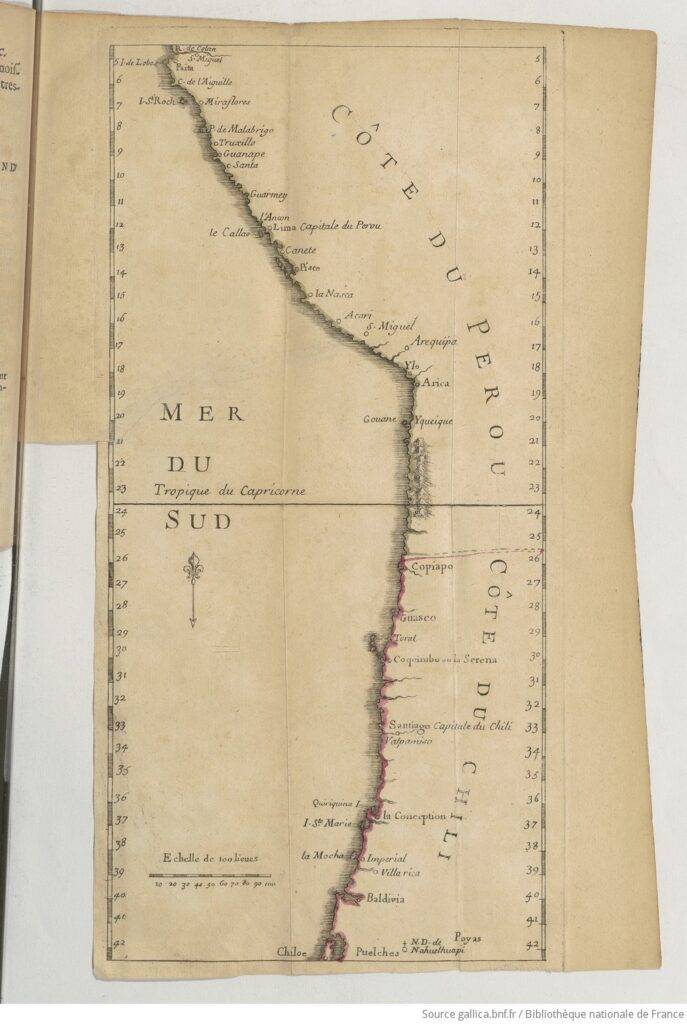
FIGURE 6. A map of the Chilean and Peruvian coast attached to Nyel’s letter. Inserted after page 60 in Charles Le Gobien, ed., Lettres édifiantes et curieuses, vol. 7, 34 vols. (Paris: Nicolas le Clerc, 1707).
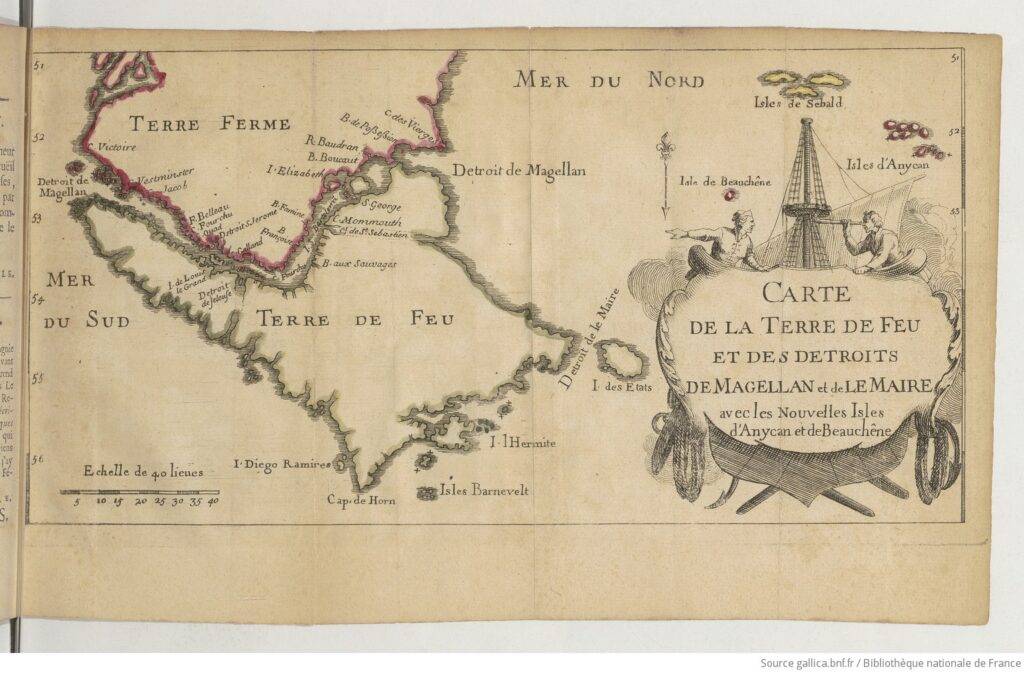
FIGURE 7. Map of the Tierra del Fuego and the straits of Magellan and Le Maire, with the new Isles of d’Anycan and de Beauchêne. Inserted before page 1 in Charles Le Gobien, ed., Lettres édifiantes et curieuses, vol. 7, 34 vols. (Paris: Nicolas le Clerc, 1707).
References
| ↑1 | Nyel, “Lettre du père Nyel”, 47. |
|---|---|
| ↑2 | Florentin, “Voyage aux Indes Orientales”, 291-92: “Nous eusmes trois mois d’une navigation très-douce ; les vents alizez qui regnent sur cette Mer, nous porterent très commodément aux Isles Marianes”. |
| ↑3 | José Ignacio García, “The Contributions of European Jesuits to Environmental Sciences”, Journal of Jesuit Studies (Leiden) 3:4 (2016), 564; Agustín Udías, Jesuit Contribution to Science: A History (Cham: Springer, 2015), 105-106. |
| ↑4 | Taillandier, “Lettre du père Taillandier”, 130-31: “Cette navigation est très douce : on n’a point à craindre de vents contraires ; et le vent qui souffle estant toujours frais, tempere la chaleur. Mais autant que le voyage est facile depuis Acapulco jusqu’à Manile, autant le retour de Manile à Acapulco est il dégoustant et dangereux”. |
| ↑5 | Cameron La Follette and Douglas Deur, “Views Across the Pacific: The Galleon Trade and Its Traces in Oregon”, Oregon Historical Quarterly 119:2 (2018), 160-191, 169. |
| ↑6 | Taillandier, “Lettre du père Taillandier”, 137: “Il y eut pendant 18 jours une pluye continuelle, qui ne cessoit que par intervalle, et pour peu de temps. Ces pluyes recommencent ainsi à plusieurs reprises jusqu’au mois de Novembre, et quelquefois jusqu’en Decembre. Alors toutes les plaines sont inondées : on se promene en Canot dans des campagnes semées de ris, lesquelles de loin paroissent des prairies agréables. Ce sont ces pluyes abondantes qui moderent la chaleur, et qui estant causées par le vent d’Ouest, rendent le climat de Manile fort humide. L’acier le mieux poli, se couvre de roüille en une nuit”. |
| ↑7 | Yves Boquet, The Philippine Archipelago (Cham: Springer, 2017), 43-48; Kshudiram Saha, Tropical Circulation Systems and Monsoons (Berlin: Springer, 2010), 24-25. |
| ↑8 | Taillandier, “Lettre du père Taillandier”, 175-76: “Dans les mers des Indes Orientales de la Cochinchine, de la Chine, des Philippines jusqu’aux Isles Marianes, ils changent régulierement selon les différentes saisons de l’année : c’est ce qu’on appelle mousson”. |
| ↑9 | Florentin, “Voyage aux Indes Orientales”, 295: “La mousson avoit change, les vents qui estoient au Sud-Oüest nous estoient contraires, et nous fusmes plus d’un mois et demi à faire 80 lieuës dans ce Canal”. |
| ↑10 | Ibid., 298: “La saison qui estoit déjà avancée, nous retint près de trois mois dans une traversée qu’on fait au temps de la mousson en moins de trois semaines”. |
| ↑11 | Mirela Altic, Encounters in the New World: Jesuit Cartography of the Americas (Chicago: University of Chicago Press, 2022), 12-15. |
| ↑12 | Florentin, “Voyage aux Indes Orientales”, 278: “Santiago est situé presque à la même élevation du pole que Mendoza”. |
| ↑13 | Ibid., 280-82. |
| ↑14 | Taillandier, “Lettre du père Taillandier”, 131, 133, 173-76. |
| ↑15 | Nyel, “Lettre du père Nyel”, 44, 51. |
| ↑16 | bid., 32: “Il me paroist assez inutile de vous faire une description de ce fameux détroit, dont Magellan, si celebre par ses voyages autour du monde, fit la premiere decouverte. J’ay mieux aimé vous en envoyer un plan correct et fidelle, fait sur les dernieres observations, qui sont beaucoup plus exactes que les précedentes”. |
| ↑17 | Ibid., 40-41: “Je dois ici remarquer, en passan une erreur assez considerable de nos Cartes anciennes et modernes, qui donnent à la Terre de Feu, qui s’étend depuis le Détroit de Magellan jusqu’à celui de le Maire, beaucoup plus d’étenduë en longitude qu’elle n’en a”. |
| ↑18 | Ibid., 46-47: “Nous avons encore remarqué ici une autre erreur de nos Cartes, qui placent le Cap de Hornes à 57 degrez et demi ; ce qui ne peut estre : car, quoy que nous nous soyons élevez jusqu’à cette hauteur, comme je viens de dire, nous sommes passez assez au large de ce Cap, et nous ne l’avons point reconnu”. |
| ↑19 | Altic, Encounters in the New World: Jesuit Cartography of the Americas, 12-13; Laurent Brassart et al., “Understanding and Controlling the Environment in Early Modern History (ca. 1500–1800)”, in The European Experience: A Multi-Perspective History of Modern Europe, 1500–2000, ed. Jan Hansen et al. (Cambridge: Open Book Publishers, 2023), 529-37; Anthony Pagden, European Encounters with the New World. From Renaissance to Romanticism (New Haven: Yale University Press, 1998), 115. |
| ↑20 | Nyel, “Lettre du père Nyel”, 44; Taillandier, “Lettre du père Taillandier”, 138. |
| ↑21 | Nyel, “Lettre du père Nyel”, 34: “Cette terre est rase et unie, entrecoupée de petites collines. Le terroir me parut assez bon, et assez propre pour estre cultivé”. |
| ↑22 | Wim De Winter, “Refuge and Hell Itself: How Two Pacific Islands Shaped the Buccaneer Presence from the Seventeenth to the Eighteenth Century”, in Entire of Itself?: Towards an Environmental History of Islands, ed. Milica Prokic and Pavla Šimková (Winwick: The White Horse Press, 2024), 167. |
To summarize, it is apparent that the letters written by Nyel, Taillandier and Florentin contain two contradictory views. On the one hand, the maritime environment was something the Jesuits had to confront. They depicted themselves as the victims of unconquerable natural processes, and only their devotion to the supernatural had been able to save them. In this way, the journey across the Pacific became a challenging test of faith. Supposedly, only the missionaries who could endure the long and dangerous voyage based on sheer zealotry were fit to preach the word of God in overseas regions. On the other hand, the maritime environment was something the Jesuits overcame. By observing, experimenting and hypothesizing, the meteorological and hydrological phenomena they encountered were not completely beyond reach. They contributed to a better understanding of nature, making it no longer unknown and dangerous but explicable and calculable. The three Jesuit voyagers thus situated themselves on a pendulum between the martyr and the scientist.
The fact that Jesuit missionaries had a strong tendency to gather information systematically is no new discovery. However, the extreme conditions at sea intensified the internal conflict between their religious and scientific attitudes, making it an important and illustrative part of missionary history. The intellectual history of the Society of Jesus and other religious orders should therefore not be limited to European colleges and overseas missions, but also take the maritime world that connected them into account. The three cases presented in this research note demonstrate that doing so can accentuate under-exposed historiographical issues. Most notably, the letters show that Jesuits not only gathered information while at sea, they related their findings to those of other navigators as well. As a consequence, concerns about the precision of naval charts and attempts to make them more accurate were not exclusive to explorers and privateers. Jesuits judged the reliability of naval routes, reported which passages were the most dangerous and disclosed the locations of ideal spots to anchor. In this way, they were as much navigators and hydrographers as they were clergymen.
Nevertheless it needs pointing out that the presence of these themes in the Edifying and Curious Letters does not necessarily represent purely objective intentions. The authors were quite aware that their correspondence would reach more readers than just the addressee. Because of this, they wrote according to the interests of the broader public, incorporating many exotic curiosities and most likely sensationalizing their experiences in some way. Furthermore, the authority given to the Parisian editors to select specific letters and to rewrite or censor specific parts should not be overlooked. In other words, the accounts of Nyel, Taillandier and Florentin were part of a deliberate propaganda effort. It is possible that the editors picked out these three letters specifically because of the extremities the authors went through. By showing the lengths missionaries were willing to go to in order to proselytize, the Society of Jesus could ramp up secular support. In addition, their ambition to make new discoveries also served their goal of opening up new opportunities for evangelization. With increased knowledge of unfamiliar regions, the Jesuits were better able to establish a presence in them. [1]Barthélemy, “Français et Jésuite”, 225-32; Danieluk, “From Manuscript to Print”, 64; Udías, Jesuit Contribution to Science, 124. Thus, to obtain a more comprehensive understanding of this subject, unpublished and unedited letters or diaries would be an interesting addition to the research. Another welcome expansion of the existing literature might be to take missionaries from either different religious orders or other European regions into account, as Spanish and Portuguese Jesuits are currently overrepresented.
References
| ↑1 | Barthélemy, “Français et Jésuite”, 225-32; Danieluk, “From Manuscript to Print”, 64; Udías, Jesuit Contribution to Science, 124. |
|---|
Primary sources
Florentin, “Voyage aux Indes Orientales par le Paraguay, le Chili, le Perou, etc”, in Lettres édifiantes et curieuses, edited by Jean-Baptiste Du Halde, vol. 13, 34 vols., 228-99 (Paris: Nicolas le Clerc, 1718).
Nyel, Jean Armand Xavier, “Lettre du père Nyel misssionnaire de la Compagnie de Jésus, au R. P. de la Chaize de la même Compagnie, confesseur du Roy”, in Lettres édifiantes et curieuses, edited by Charles Le Gobien, vol. 7, 34 vols., 29-60 (Paris: Nicolas le Clerc, 1707).
Taillandier, “Lettre du père Taillandier, missionnaire de la Compagnie de Jésus, au père Willard de la mesme Compagnie”, in Lettres édifiantes et curieuses, edited by Jean-Baptiste Du Halde, vol. 9, 34 vols., 92-179 (Paris: Nicolas le Clerc, 1715).
Secondary sources
Acuña, Isidoro Vázquez de, and García del Postigo, “Los Navegantes Franceses En Chile (1695–1727)”, Boletin de la Academia Chilena de la Historia 110 (2001 2000), 217-54.
Altic, Mirela, Encounters in the New World: Jesuit Cartography of the Americas (Chicago: University of Chicago Press, 2022).
Barthélemy, Sarah, “Les Lettres Édifiantes et Curieuses de Chine, Entreprise Éditoriale de La Mission Jésuite Française (1702–1783)”, Revue d’Histoire Ecclésiastique 114:1-2 (2019), 224-64.
Bély, Lucien, “Les négociations franco-espagnoles pendant la Guerre de Succession d’Espagne”, Cuadernos de Historia Moderna 1 (2013), 61-76.
Boquet, Yves, The Philippine Archipelago (Cham: Springer, 2017).
Brassart, Laurent, Jessica Dijkman, Jan Hansen, and Jiří Janáč, “Understanding and Controlling the Environment in Early Modern History (ca. 1500–1800)”, in The European Experience: A Multi-Perspective History of Modern Europe, 1500–2000, edited by Jan Hansen, Jochen Hung, Jaroslav Ira, Judit Klement, Sylvain Lesage, Jan Luis Simal, and Andrew Tompkins, 529-37 (Cambridge: Open Book Publishers, 2023).
Brockey, Liam, “Largos Caminhos e Vastos Mares: Jesuit Missionaries and the Journey to China in the Sixteenth and Seventeenth Centuries”, Bulletin of Portuguese-Japanese Studies 1 (2000), 45-72.
Dahlgren, E. W. Voyages français à destination de la Mer du Sud avant Bougainville (1695–1749) (Paris: Imprimerie Nationale, 1907).
Danieluk, Robert, “From Manuscript to Print. At the Origins of Early Jesuit Missionary Strategies of Communication”, in Reimagining the Globe and Cultural Exchange. The East Asian Legacies of Matteo Ricci’s World Map, edited by Laura Hostetler, 45-81 (Leiden: Brill, 2024).
De Winter, Wim, “Refuge and Hell Itself: How Two Pacific Islands Shaped the Buccaneer Presence from the Seventeenth to the Eighteenth Century”, in Entire of Itself?: Towards an Environmental History of Islands, edited by Milica Prokic and Pavla Šimková (Winwick: The White Horse Press, 2024).
Dehergne, Joseph, Répertoire Des Jésuites de Chine, de 1542 à 1800 (Rome: Institutum Historicum Societatis Iesu, 1973).
Desgreves, Roger Martin Desgreves and Julien Thomas-Cadiou, Navires de Saint Malo des XVIIe et XVIIIe siècles (Rennes: Association Parchemin, 1992).
Follette, Cameron La, and Douglas Deur, “Views Across the Pacific: The Galleon Trade and Its Traces in Oregon”, Oregon Historical Quarterly 119:2 (2018), 160-91.
García, José Ignacio, “The Contributions of European Jesuits to Environmental Sciences”, Journal of Jesuit Studies (Leiden) 3:4 (2016), 562-76.
Gottmann, Felicia, “French-Asian Connections: The Compagnie Des Indes, France’s Eastern Trade, and New Directions in Historical Scholarship”, The Historical Journal 56:2 (2013), 537-52.
Govorushko, Sergey M, Natural Processes and Human Impacts (Dordrecht: Springer, 2012).
Harris, Steven J, “Mapping Jesuit Science. The Role of Travel in the Geography of Knowledge”, in The Jesuits. Cultures, Sciences, and the Arts 1540–1773, edited by John W. O’Malley, Gauvin Alexander Bailey, Steven J. Harris, and T. Frank Kennedy, 212-40 (Toronto: University of Toronto Press, 1999).
Lévesque, Rodrigue, “French Ships at Guam, 1708–1717: Introduction to a Little-Known Period in Pacific History”, The Journal of Pacific History 33:1 (1998), 105-10.
Lincoln, Margarette, “Shipwreck Narratives of the Eighteenth and Early Nineteenth Century: Indicators of Culture and Identity”, Journal for Eighteenth-Century Studies 20:2 (1997), 155-72.
Martin, Jean, “Les toiles bretagnes dans le commerce franco-espagnol de 1550 à 1830”, Annales de Bretagne et des Pays de l’Ouest 119:1 (2012), 31-60.
Pagden, Anthony, European Encounters with the New World. From Renaissance to Romanticism (New Haven: Yale University Press, 1998).
Saha, Kshudiram, Tropical Circulation Systems and Monsoons (Berlin: Springer, 2010).
Salomoni, David, “A Catholic Conceptualization of the Pacific Ocean: The Mental Geography of Giambattista Lucarelli on His Journey from Mexico to China (1578)”, in The Spanish Pacific, 1521–1815: A Reader of Primary Sources, edited by Christina H. Lee and Ricardo Padrón, 105-18 [Connected Histories in the Early Modern World] (Amsterdam: Amsterdam University Press, 2024).
———, “Jesuits on Board. A Reasoned Bibliogaphy on the Early Modern Jesuit Trans-Oceanic Sailing Experiences”, RUTTER Technical Notes 3 (Lisbon: ERC RUTTER Project, University of Lisbon, 2020).
Schottenhammer, Angela, “Some Insights into the Medical Situation on Board of Galleons Traveling across the Pacific Ocean in the Eighteenth Century”, Asian Review of World Histories 12 (2024), 319-48.
Tempère, Delphine, “L’épreuve du voyage en mer pour les missionnaires jésuites : souffrances et émotions de passage”, Annales de Bretagne et des Pays de l’Ouest 121:3 (2014), 177-97.
———, “Marins et missionnaires face aux dangers des navigations océaniques au XVIIe siècle : Catastrophes, recours matériels et médiations spirituelles”, e-Spania 12 (2011). https://doi.org/10.4000/e-spania.20832.
Udías, Agustín, Jesuit Contribution to Science: A History (Cham: Springer, 2015).
List of Illustrations
FIGURE 1: Estimated Routes of Nyel, Taillandier, and Florentin’s voyages, based on the locations mentioned in their letters. Nyel’s letter was sent from Lima, but claimed that he would soon find passage to Acapulco and continue on to China. By author.
FIGURE 2: French ships departing to and returning from the Pacific. From Dahlgren, Voyages français à destination de la Mer du Sud avant Bougainville (1695–1749) (Paris: Imprimerie Nationale, 1907), 446.
FIGURE 3: Ships departing from Saint-Malo with destinations Chili, Chine, Mers du Sud, Mexique, and/or Pérou. Data from Roger Martin Desgreves and Julien Thomas-Cadiou, Navires de Saint-Malo des XVIIe et XVIIIe siècles (Rennes: Association Parchemin, 1992).
FIGURE 4: Shipwrecked sailors climb onto a rock during a storm. Jacques Rigaud, Ils font naufrage, ca. 1700–ca. 1725, print, 190 x 273 mm (Amsterdam, Rijksmuseum, RP-P-2008-511-12, https://id.rijksmuseum.nl/200763131).
FIGURE 5: A map depicting air currents in the Pacific Ocean. Herman Moll, A view of the general and coasting trade-winds in the great South Ocean (London, 1697?, Sydney, State Library of New South Wales, M2 110/1697/1, https://collection.sl.nsw.gov.au/record/74VvND6QdzXM.)
FIGURE 6: A map of the Chilean and Peruvian coast attached to Nyel’s letter. Inserted after page 60 in Charles Le Gobien, ed., Lettres édifiantes et curieuses, vol. 7, 34 vols. (Paris: Nicolas le Clerc, 1707).
FIGURE 7: Map of the Tierra del Fuego and the straits of Magellan and Le Maire, with the new Isles of d’Anycan and de Beauchêne. Inserted before page 1 in Charles Le Gobien, ed., Lettres édifiantes et curieuses, vol. 7, 34 vols. (Paris: Nicolas le Clerc, 1707).